Tip-Cat in A Little Pretty Pocket-Book, Intended for the Instruction and Amusement of Little Master Tommy, and Pretty Miss Polly (1787 edition) The phrase to see which way the cat jumps means to see what direction events are taking before committing oneself. One of its earliest instances is from The Berkshire Chronicle […]
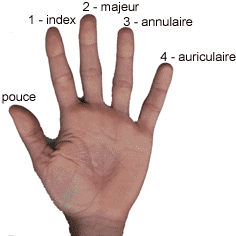
In the Etymologies (Etymologiarum sive Originum libri viginti), compiled between around 615 and the early 630s in the form of an encyclopaedia arranged by subject matter, St Isidore (circa 560–636), bishop of Seville and Doctor of the Church, wrote the following about the names of the fingers (the original Latin words are […]
The phrase not a cat in hell’s chance means no chance at all—synonyms: a snowball’s chance (in hell) and a Chinaman’s chance. It is a shortening of the more explicit no more chance than a cat in hell without claws. The earliest instance of this phrase that I have found is from Jackson’s Oxford Journal of 29th September 1753: Poor […]
The adjective fed up means annoyed, unhappy or bored, especially with a situation that has existed for a long time. The original, literal meaning is simply sated with food, since to feed up an animal or a person is to supply them with rich and abundant food. For example, the author of Whether Love be a natural or fictitious Passion, published in Pope’s Bath Chronicle of 3rd May 1764, wrote: The […]
One of the earliest instances of posh is from a cartoon published in Punch, or The London Charivari (London, England) of 25th September 1918. An RAF officer is talking to his mother: “Oh, yes, Mater, we had a posh time of it down there.” “Whatever do you mean by ‘posh,’ Gerald?” “Don’t you know? […]
Aunt Sally – from The Modern Playmate: A book of games, sports, and diversions for boys of all ages (new revised edition – 1875?), by John George Wood (1827-89) The Oxford English Dictionary (first edition – 1885) thus defined Aunt Sally: a game much in vogue at fairs and races, in which […]
The term field bishop denotes a person who is hanged and imagined as grotesquely giving a benediction with his jerking legs. It is first recorded in A mysterye of inyquyte contayned within the heretycall genealogye of Ponce Pantolabus (1545), by John Bale (1495-1563), Bishop of Ossory, evangelical polemicist and historian: What your ende shall be […]
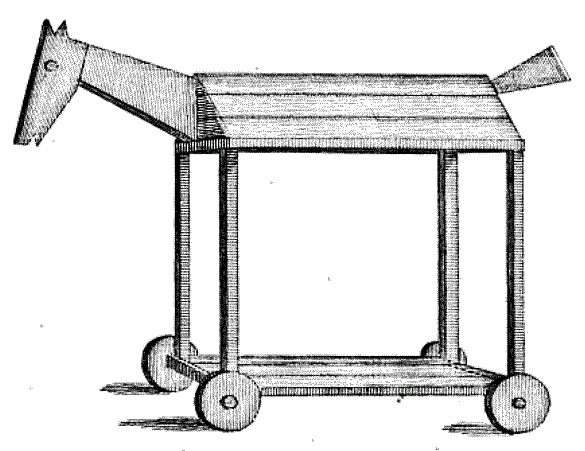
The phrase a horse that was foaled of an acorn denoted the gibbet, sometimes also called triple tree. In A Collection of English Proverbs (1678), the English naturalist and theologian John Ray (1627-1705) wrote: You’ll ride on a horse that was foal’d of an acorn. That is the gallows. Pelham; or, The Adventures […]
MEANING of payments: without delay ORIGIN This expression refers to the fingernail and might originally have alluded to drinking fair and square. A clue might be provided by the French phrase payer rubis sur l’ongle (literally to pay ruby on the fingernail), which means to pay exactly what is due. (A variant, used by prostitutes, was rubis sur pieu, […]
Among other figurative meanings, the adjective thick has the sense of close in confidence and association, intimate, familiar. In Literary Anecdotes of the Eighteenth Century, published in 1812, John Nichols quoted Edmund Law (1703-87), Bishop of Carlisle: “Yes,” said he, “we begin now, though contrary to my expectation, and without my seeking, to be pretty thick; and I thank God, who reconciles me to […]




 word histories