‘the whole caboodle’: meaning and origin
USA, 1839—the whole group or set of people, animals or things—origin unknown—perhaps from the Dutch expression ‘de hele kit en boedel’, meaning ‘the entire house and everything in it’
Read More
“ad fontes!”
USA, 1839—the whole group or set of people, animals or things—origin unknown—perhaps from the Dutch expression ‘de hele kit en boedel’, meaning ‘the entire house and everything in it’
Read MoreUK, 1710—in a situation in which any action one takes will have adverse consequences—‘cleft’, past participle of the verb ‘cleave’, means ‘split in two to a certain depth’—the image is of one being squeezed between the stick’s prongs
Read MoreUSA, 1927—a conventional film ending, regarded as sentimental or simplistic, and often featuring an improbably positive outcome—by extension: an improbably positive outcome to a real-life situation
Read MoreAustralia, 1982—a familiar name given to the Long Bay Correctional Complex, a correctional facility located in Malabar, Sydney, New South Wales
Read MoreAustralia, 1863—originally referred to any chain of communications by which bushrangers were warned of police movements—soon extended to any rapid informal network by which information, rumour, gossip, etc., is spread
Read MoreUSA, 1917—a method of treating a drug addict by sudden and complete withdrawal of the drug, instead of by a gradual process—alludes to the goose pimples, resembling the skin of a cold turkey, that a person experiences as a side effect of the treatment
Read MoreUK, 1860—very much, very intensely—‘billy-o’ occurs only in this phrase—it is apparently composed of ‘Billy’, pet form of the male forename ‘William’, and the suffix ‘-o’, used to form slang and colloquial nouns, adjectives and interjections
Read More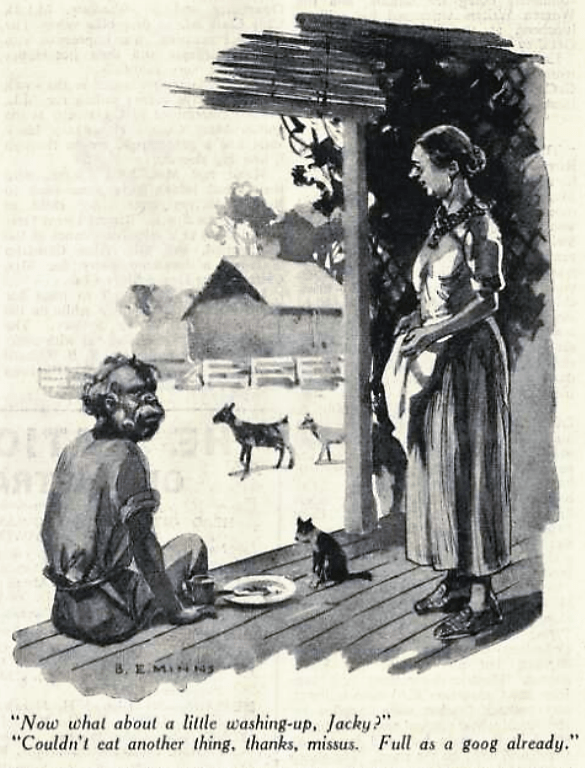
Australia, 1927—very drunk; sated with food—‘goog’, Australian-English slang for an egg, was perhaps formed on the sense of ‘gog’ in ‘goosgog’, denoting a gooseberry
Read MoreAustralia, 1982—a stretch of Oxford Street, in Sydney, which is the city’s main gay district—refers to the use of Vaseline to ease anal intercourse, and based on the alliteration in /v/
Read More19th century—refer to two handkerchiefs, one used as a clothing accessory, the other for blowing the nose—hence, figuratively ‘for display rather than for use’ and ‘one for display and one for use’
Read More word histories