‘the whole box and dice’: meaning and origin
Australia, 1828—Ireland, 1832—a group of things or people in its entirety—‘box’ refers to a box from which dice are thrown in gaming or gambling
Read More
“ad fontes!”
Australia, 1828—Ireland, 1832—a group of things or people in its entirety—‘box’ refers to a box from which dice are thrown in gaming or gambling
Read More
1757, as a loan translation of German ‘Eiserne Jungfer’ (German text published in 1740)—1837, as a loan translation of German ‘Eiserne Jungfrau’—an instrument of torture, supposedly used during the Middle Ages, consisting of an upright coffin-shaped box lined with iron spikes, into which the victim is shut
Read MoreUK, 1806—very rapidly and thoroughly—refers to a dose of aperient salts—has come to be also used in the extended form ‘like a dose of salts through + noun’
Read MoreUSA, 1893—the part of a town or city in which prostitution and other commercial sexual activities are concentrated—originally used of Louisville, Kentucky—from the use of a red light as a sign outside a brothel
Read More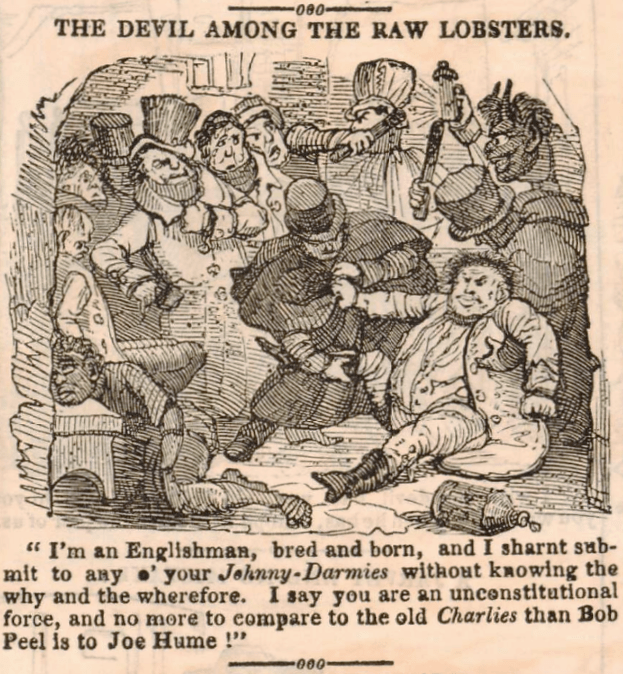
UK, 1830—‘Jenny Darby’, ‘Johnny Darm’, and variants, were originally opprobrious names for any member of the new Metropolitan Police introduced in 1829 by Robert Peel—alterations of ‘gendarme’, with full or partial folk-etymological remodelling variously after the female forename ‘Jenny’, the male forename ‘Johnny’, and the surname ‘Darby’
Read MoreIreland, 1809—the Wednesday before Easter—refers to the day on which Judas Iscariot formed the intent to betray Jesus—‘spy’ denotes ‘one who spies upon, or watches, a person or persons secretly’, because, from Wednesday onwards, Judas Iscariot secretly sought an opportunity to deliver Jesus to the Jewish authorities
Read MoreNorthern England—a filled or open sandwich—originally (1827): a slice of bread spread with butter—composed of ‘butt-’, from the noun ‘butter’, and the suffix ‘-y’, forming diminutive nouns
Read MoreUSA, 1812—UK, 1818—the name of a character proverbially said to have been so great a liar that he was expelled from Hell—hence, frequently in ‘a bigger liar than Tom Pepper’, and variants: an outrageous liar
Read More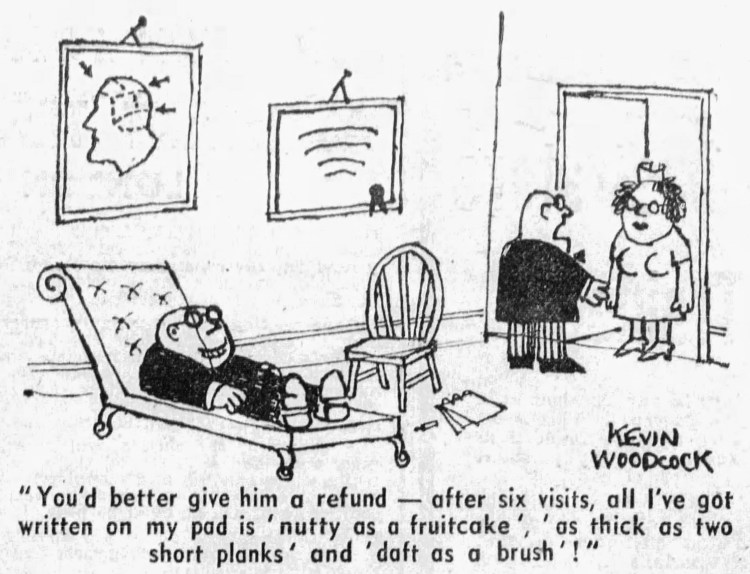
UK, 1954—very stupid—the humorous arbitrary comparison with ‘two short planks’ gives emphasis to the adjective ‘thick’, meaning stupid
Read MoreLancashire, England, 1833—a faggot, a meatball, “a compound of onions, flour, and small pieces of pork” (The Liverpool Echo, 20 August 1880)—probably one of the common dishes humorously named after daintier items of food
Read More word histories