Originally meaning ‘person of ridiculous appearance’, ‘quiz’ (students’ slang, late 18th century) was jocularly derived from the Latin interrogative pronoun ‘quis’ in “Vir bonus est quis?” (“Who is a good man?”)—a good, ingenuous, harmless man being likely to become an object of ridicule or even of harassment.
In a letter that she wrote to her sister in December 1797, the English novelist, diarist and playwright Madame d’Arblay (née Frances Burney – 1752-1840) gave an account of a conversation with Princess Augusta, daughter of King George III (Sarah Siddons (1755-1831), one of the greatest English tragediennes, had bought Sadler’s Wells, a London […]
The informal British phrase to chance one’s arm means to undertake something although it may be dangerous or unsuccessful. Its origin is unclear. The earliest use that I have found is from How our blue-jackets are fed, an article about the “diet of the British sailor at sea” published in The Weekly Telegraph […]
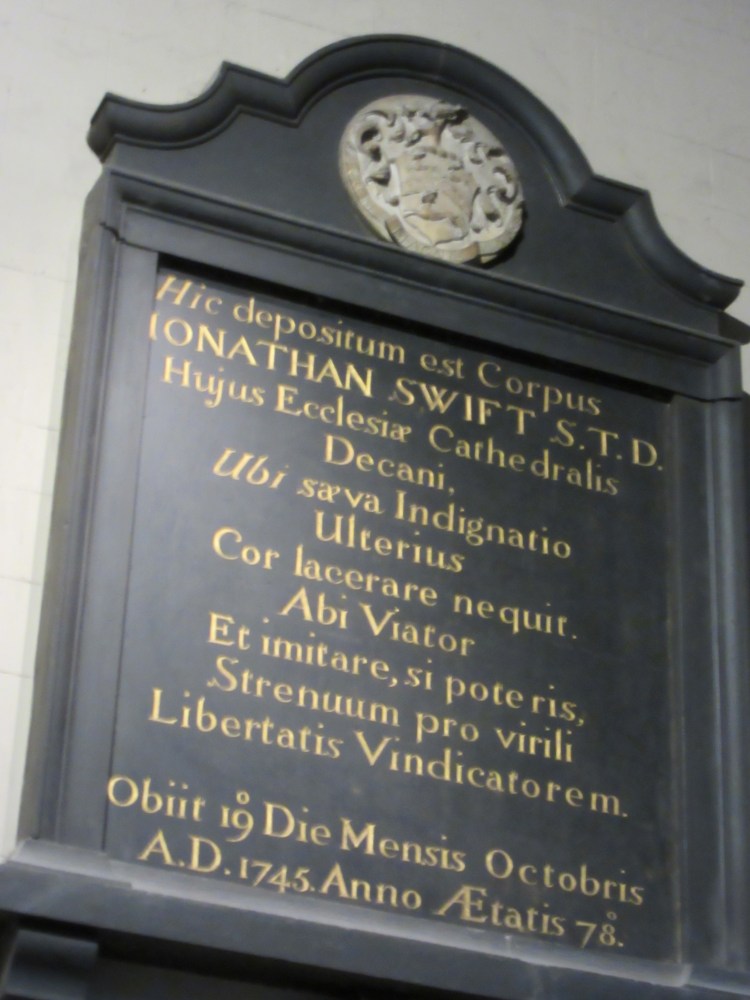
Jonathan Swift’s grave, marked by a simple brass plaque on the floor at the west end of St Patrick’s Cathedral, Dublin, is adjacent to that of his great friend in life, Stella (Esther Johnson – 1681-1728): plaques marking the graves of Jonathan Swift and Esther Johnson Latin sæva indignatio, meaning savage indignation, expresses a […]
The term thinking cap denotes an imaginary cap humorously said to be worn in order to facilitate thinking. The earliest instance that I have found is from the Western Carolinian (Salisbury, North Carolina) of 16th October 1821: We advise the editor to put his thinking-cap on, before he hazards another such assertion. The term also […]
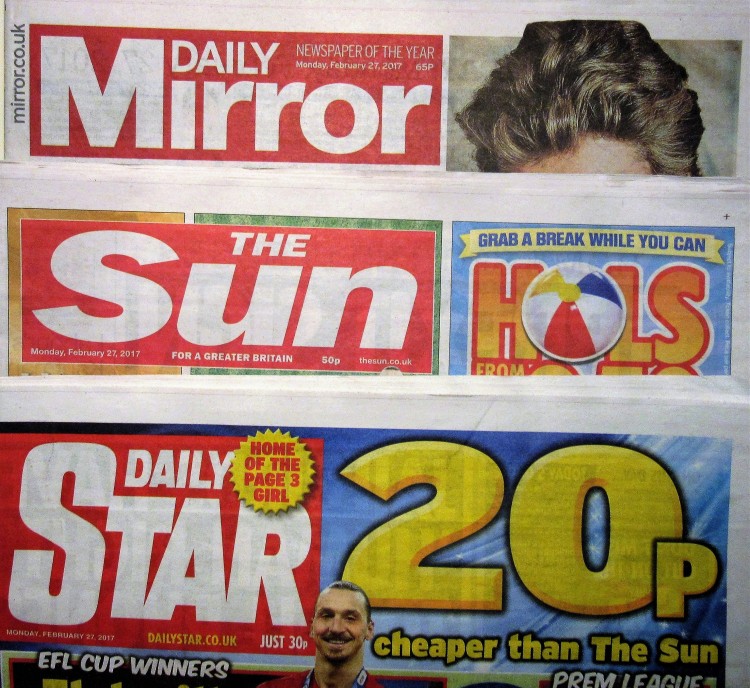
three red tops: the Daily Mirror, The Sun, the Daily Star In the following, the noun tabloid has the sense of a newspaper having pages half the size of those of the average broadsheet, aimed at the mass market, with relatively little serious political or economic content but considerable amounts of sport, celebrity gossip, scandal and trivial […]
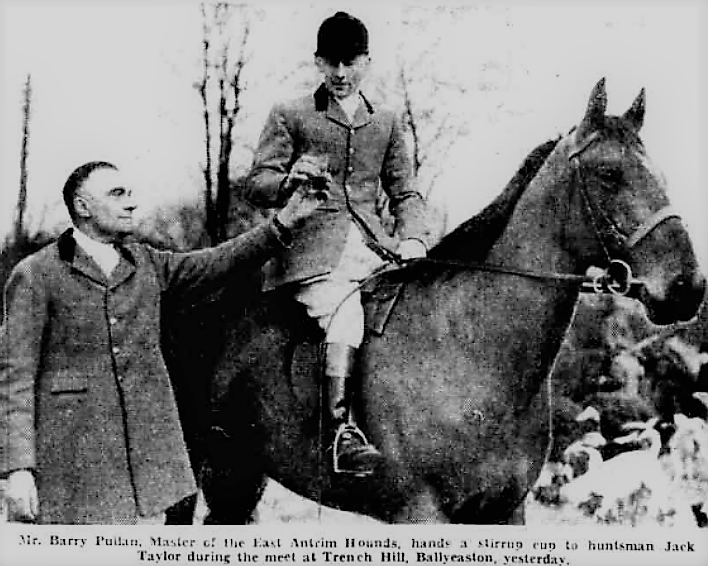
Huntsmen still use stirrup cup to designate an alcoholic drink offered to riders either as they are about to depart or when they return. Mr. Barry Puilan, Master of the East Antrim Hounds, hands a stirrup cup to huntsman Jack Taylor during the meet at Trench Hill, Ballyeaston, yesterday. from The Northern Whig and Belfast […]
The expression to amputate one’s mahogany is a jocular elaboration on to cut one’s stick, which means to take one’s departure. The following definition is from A Dictionary of Modern Slang, Cant, and Vulgar Words (2nd edition – 1860), by the English publisher and author John Camden Hotten (1832-1873): Cut one’s stick, to be off […]
‘blarney’: originally an allusion to the lies told by those who, having not reached the Blarney stone (in a castle near Cork), explained how they did reach it
The adjective teetotal in the sense of choosing, or characterised by, total abstinence from all alcohol seems to have first been used about September 1833 by Richard Turner, a worker from Preston, Lancashire, in a speech advocating total abstinence from intoxicating liquors, in preference to abstinence from ardent spirits only (as practised by some early […]