cloak: twin roses designs The nouns clock and cloak are doublets, or etymological twins: they are of the same derivation but have different forms and meanings. Despite the notion of ‘two’ implied by doublet, the term is also applied to sets of more than two words. In this case, cloche, a borrowing from French, […]
the 1905 edition of Le Petit Larousse illustré, a French-language encyclopaedic dictionary published by the Éditions Larousse In 1890, Eugène Grasset (1845-1917) designed the image of la Semeuse (the Sower) blowing dandelion seeds, which accompanies the motto of the Éditions Larousse, Je sème à tout vent (I sow to the four winds). The word […]
The word tennis in its current sense is short for lawn tennis. The original form of tennis (known as real tennis to distinguish it from the later lawn tennis) was played with a solid ball on an enclosed court divided into equal but dissimilar halves, the service side (from which service was always delivered) and […]
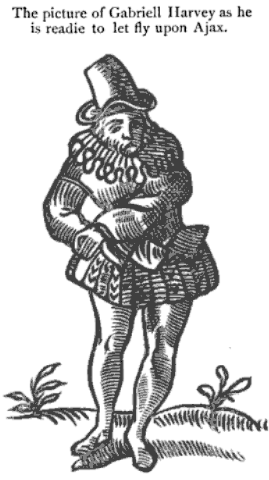
Caricature of Gabriel Harvey from Haue with you to Saffron-walden. Or, Gabriell Harueys hunt is vp (1596), by Thomas Nashe. Entitled The picture of Gabriell Harvey as he is readie to let fly upon Ajax, this caricature depicts him rushing to the toilet at the thought of Nashe’s publication. Ajax was a pun on […]
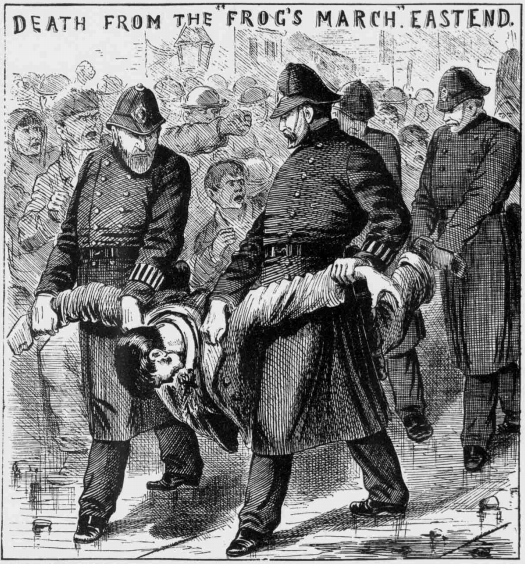
The verb to frog-march (somebody) means to force (somebody) to walk forward by holding and pinning their arms from behind. This sense is milder than the original, as the frog’s march was a police metaphor denoting a method of moving a resistant person such as a prisoner, in which he or she is lifted by […]
In early use, apple was a general term for all kinds of fruits other than berries, including even nuts. In fact, apple and berry are the only Anglo-Saxon fruit names, the rest being of Latin or ‘exotic’ origin. This is why apple was commonly used in describing foreign fruits, which explains for example the word […]
MEANING a young man paid or financially supported by a woman, typically an older woman, to be her escort or lover ORIGIN In English, gigolo originally denoted a professional male dancing-partner. One of its first users was the American novelist, short story writer and playwright Edna Ferber (1885-1968) in Gigolo, which was published in […]