mandragoras – from Stirpium historiae pemptades sex sive libri XXX (1583), by Rembert Dodoens The term hand of glory originally denoted a charm made from, or consisting of, the root of a mandrake. A calque of French main de gloire, it was first used in Curiosities of nature and art in husbandry […]
MEANING the depths of one’s conscience or emotions ORIGIN This anatomically curious but firmly established expression is a variant of the older and more comprehensible heart of heart, meaning very centre of the heart, which was coined by the English poet and playwright William Shakespeare (1564-1616) in The Tragicall Historie of Hamlet, […]
In The English Struwwelpeter and the Birth of International Copyright (The Library, journal of the Bibliographical Society, 2013), Jane Brown and Gregory Jones explain that the ancient free city of Frankfurt am Main saw in 1845 the first appearance of Dr Heinrich Hoffmann¹’s Lustige Geschichten und drollige Bilder², a German children’s Christmas picture book. […]
The noun window is from Middle English windoȝe, a borrowing from Old Norse vindauga, literally wind’s eye, from vindr, wind, and auga, eye. The Scandinavian word replaced and finally superseded Old English éagþyrel, i.e. eyethirl, composed of the nouns eye and thirl. The noun thirl denoted a hole, an aperture, and was derived from Old English þurh, thorough. It was long used in some dialects of English; for instance, […]
A drawing of Peeping Tom, in the exact state in which he is carved, but divested of all paint and superfluous ornaments. W. Reader in The Gentleman’s Magazine: and Historical Chronicle (London) of July 1826 The Coventry Peeping Tom statue, which dates from around 1500, survives today. Though it is now stripped down to […]
The English adjective pregnant has several meanings: carrying a fetus or fetuses within the womb, full of meaning or significance, inventive or imaginative, prolific or fruitful. It is from the Latin adjective praegnans/praegnant-, with child, pregnant, variant of praegnas/praegnat-, probably from the prefix prae-, before, and the stem of the verb gnasci (past participle gnatus), […]
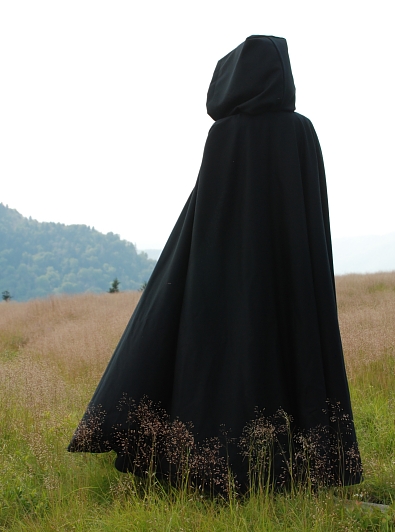
cloak: twin roses designs The nouns clock and cloak are doublets, or etymological twins: they are of the same derivation but have different forms and meanings. Despite the notion of ‘two’ implied by doublet, the term is also applied to sets of more than two words. In this case, cloche, a borrowing from French, […]
the 1905 edition of Le Petit Larousse illustré, a French-language encyclopaedic dictionary published by the Éditions Larousse In 1890, Eugène Grasset (1845-1917) designed the image of la Semeuse (the Sower) blowing dandelion seeds, which accompanies the motto of the Éditions Larousse, Je sème à tout vent (I sow to the four winds). The word […]
The word tennis in its current sense is short for lawn tennis. The original form of tennis (known as real tennis to distinguish it from the later lawn tennis) was played with a solid ball on an enclosed court divided into equal but dissimilar halves, the service side (from which service was always delivered) and […]
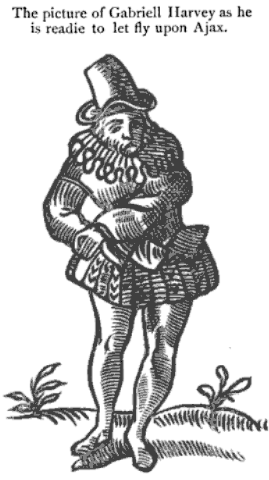
Caricature of Gabriel Harvey from Haue with you to Saffron-walden. Or, Gabriell Harueys hunt is vp (1596), by Thomas Nashe. Entitled The picture of Gabriell Harvey as he is readie to let fly upon Ajax, this caricature depicts him rushing to the toilet at the thought of Nashe’s publication. Ajax was a pun on […]




 word histories