Primary Menu
  • home
  • alphabetical index
  • about me
  • contact
  • donate
word histories

word histories

“ad fontes!”

Tag: human body

meaning and origin of the phrase ‘nudge, nudge’

25th Nov 2019.Reading time 9 minutes.

draws attention to a sexual innuendo—generally refers to an October 1969 sketch from the British comedy series Monty Python’s Flying Circus—but in use earlier

Read More

the British phrase ‘bless my—or another’s—cotton socks’

22nd Nov 2019.Reading time 7 minutes.

1930 ‘bless my cotton socks’: exclamation of surprise, consternation, etc.—1935 ‘bless another’s cotton socks’: expresses affection, benevolence or gratitude

Read More

‘Charlie’s dead’ (your petticoat is showing)

18th Nov 2019.Reading time 12 minutes.

UK, 1950s—used among schoolgirls when one’s petticoat was showing (origin unknown)—synonyms: ‘it’s snowing again’, ‘you’re showing next week’s washing’

Read More

meaning and origin of the phrase ‘jam and Jerusalem’

15th Nov 2019.Reading time 5 minutes.

UK, 20th century—the Women’s Institutes—‘jam’, from jam-making as a typical activity practised by members—‘Jerusalem’, the hymn that members sing at meetings

Read More

the Australian phrase ‘to kill a brown dog’: meanings, origin

10th Nov 2019.Reading time 13 minutes.

1950—used of a substance causing death or illness, and by extension of something powerful or disastrous—refers to red kelpie sheep dogs, who can ingest anything

Read More

meanings of the British phrase ‘vicarage tea-party’

9th Nov 2019.Reading time 10 minutes.

20th century—denotes something mild, innocuous or uneventful—but those notions have been associated with vicarage tea-parties since the 19th century

Read More

‘wallflower’ | ‘faire tapisserie’: on the fringes of a dance

3rd Nov 2019.Reading time 5 minutes.

UK 1801 ‘wallflower’—France 1806 ‘faire tapisserie’ (= ‘to do tapestry’)—in both cases because the person keeps their seat at the side of a room during dancing

Read More

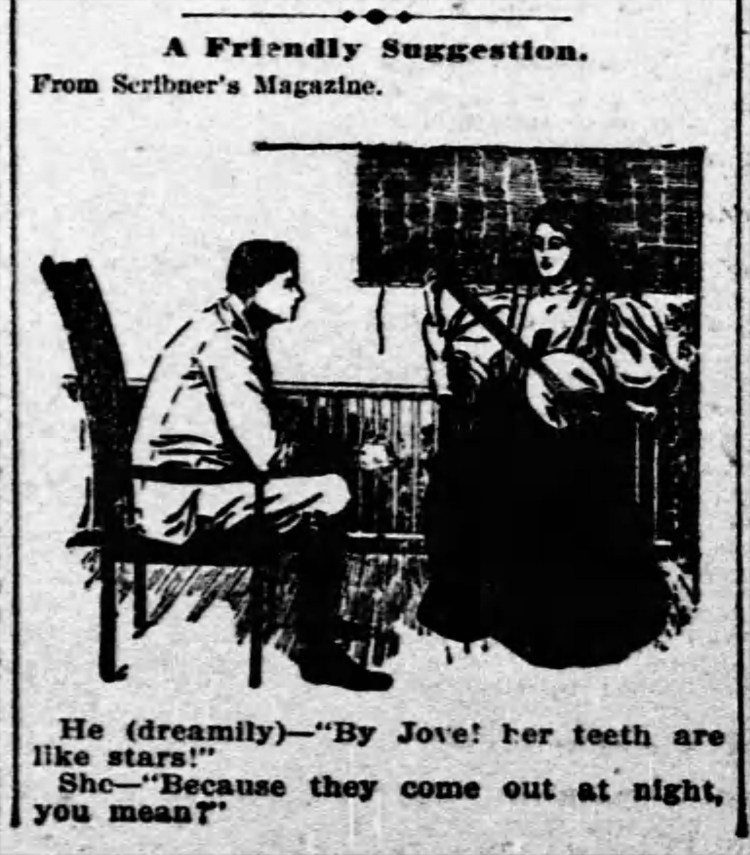
history of ‘did it hurt when you fell from heaven?’

29th Oct 2019.Reading time 13 minutes.

originally a chat-up line that supposedly met a demand for originality (USA 1985)—while it soon became one of the favourite lines used by men, women loathe it

Read More

the origin and various meanings of ‘buy me and stop one’

24th Oct 2019.Reading time 9 minutes.

UK, 1970s: frequently scrawled on contraceptive-vending devices in public conveniences—reversal of ‘stop me and buy one’, Wall’s Ice Cream advertising slogan

Read More

meaning and history of the phrase ‘feed the brute’

17th Oct 2019.Reading time 12 minutes.

nourish your husband—1882 in ‘Vanity Fair’ (London)—popularised in 1885 by a cartoon by George du Maurier, published in ‘Punch, or the London Charivari’

Read More

Posts navigation

Older Posts
Newer posts
Creative Commons License
All posts by word histories are licensed under a Creative Commons Attribution-NonCommercial-NoDerivatives 4.0 International Licence.

Search this blog

Enter your email address to follow this blog and receive notifications of new posts by email.

Join 879 other subscribers.
Follow word histories on WordPress.com

Categories

arts Australia & New Zealand etymology French/English linguistics literature media music public affairs religion symbolisms uncategorised United Kingdom & Ireland USA & Canada

Main Tags

animals Australia Christianity dictionaries drinks economics food human body Ireland judicial Latin military newspapers & magazines phrases politics slang sports & games theatre United Kingdom USA

links

  • Académie française
  • Australian newspapers, magazines and journals, books, and other formats
  • British and Irish newspaper archive
  • Chronicling America: Historic American Newspapers
  • CNRTL (Centre national de ressources textuelles et lexicales)
  • Collins Dictionary
  • Dictionaries of the Scots Language / Dictionars o the Scots Leid
  • Dictionary of South African English
  • English, French and Latin dictionaries
  • Gallica (bibliothèque numérique de la Bibliothèque nationale de France)
  • Irish newspaper archive
  • Lexilogos (a comprehensive set of resources for the study of the languages of the world)
  • Llyfrgell Genedlaethol Cymru / The National Library of Wales
  • Merriam-Webster Dictionary
  • New-Zealand and Pacific newspapers, magazines and journals, books, and other formats
  • Newspaper archive
  • The Australian National Dictionary
  • U.S. newspaper archive

  • Subscribe Subscribed
    • word histories
    • Join 879 other subscribers.
    • Already have a WordPress.com account? Log in now.
    • word histories
    • Subscribe Subscribed
    • Sign up
    • Log in
    • Report this content
    • View site in Reader
    • Manage subscriptions
    • Collapse this bar
This website uses cookies. By continuing, you agree to their use. Learn more, including how we use cookies and how you can change your settings.
 

Loading Comments...