‘papyrocracy’: meanings and origin
originally (1830): the rule, or the power, of paper money (as opposed to metallic currency)—later also (1940): the rule, or the power, of bureaucracy
Read More
“ad fontes!”
originally (1830): the rule, or the power, of paper money (as opposed to metallic currency)—later also (1940): the rule, or the power, of bureaucracy
Read Morea moment of sudden discovery, inspiration or insight—1918—from the reputed exclamation of Archimedes when he realised that the volume of a solid could be calculated by measuring the water displaced when it was immersed
Read Moreto make bigger or greater, to enlarge—UK, 1884, as a translation of ancient Greek ‘μεγαλύνειν’ as used in the Acts of the Apostles, 5:13—recoined in 1996 in the U.S. animated television series The Simpsons
Read More1609—to add to what is already great, also to add difficulty to difficulty—Pelion and Ossa are two mountains in Thessaly—in Greek mythology, two giants, Otus and Ephialtes, tried to pile Pelion and Ossa on Olympus in order to reach the gods and overthrow them
Read More[Preliminary note: All the biblical quotations in English are from the New International Version (2011).] Le Notre-Père, the French version of the Lord’s Prayer, was revised in La Bible : Traduction officielle liturgique (Paris: Éditions Mame, 2013), the official liturgical translation of the Bible. French-speaking Catholics used to say: Et ne nous soumets pas à la […]
Read Moreto refuse to face up to unpleasant or awkward realities—refers to the practice traditionally attributed to the ostrich of thrusting its head into the sand when being overtaken by pursuers, supposedly through an incapacity to distinguish between seeing and being seen
Read MoreUK—‘rhubarb’ is colloquially used to denote ‘nonsense’—originated in the theatrical practice consisting for a group of actors in repeating the word ‘rhubarb’ to represent an indistinct background conversation or the noise of a crowd
Read More1762—(especially of an ancient style of writing): having alternate lines written from left to right and from right to left—from the Greek adverb ‘βουστροφηδόν’, meaning literally ‘as an ox turns (in ploughing)’, with allusion to the course of the plough in successive furrows
Read MoreUK, 1849—transformation into a pumpkin; extravagant or absurdly uncritical glorification—coined after Hellenistic Greek ‘ἀποκολοκύντωσις’, the title of a travesty ascribed to Seneca, according to which the deceased Roman emperor Claudius, instead of being elevated to divine status, is changed into a pumpkin
Read More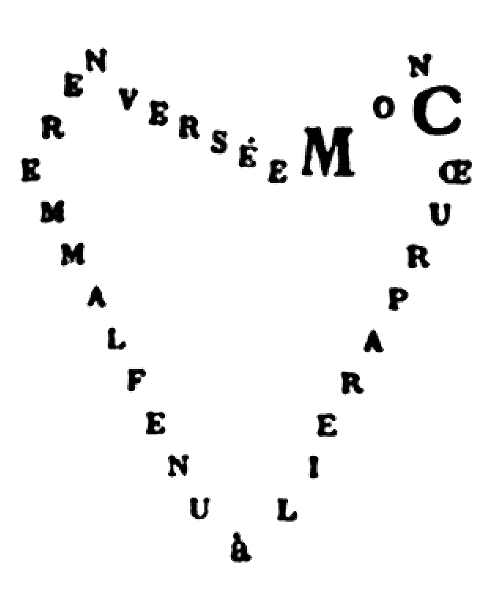
a word or piece of text in which the design and layout of the letters creates a visual image related to the meaning of the words themselves—from French ‘calligramme’, coined in 1918 by the French poet Guillaume Apollinaire—from ‘calligraphie’ and ‘idéogramme’
Read More word histories