origin of ‘Yorkshire tyke’ (nickname for a person from Yorkshire)
The word ‘tyke’, a nickname for a person from Yorkshire, originally meant ‘mongrel’. The people from Yorkshire have adopted it as a term of self-reference.
Read More
“ad fontes!”
The word ‘tyke’, a nickname for a person from Yorkshire, originally meant ‘mongrel’. The people from Yorkshire have adopted it as a term of self-reference.
Read More
‘(As) mad as a March hare’ refers to the fact that, in the breeding season, the hare is characterised by much leaping, boxing and chasing in circles.
Read More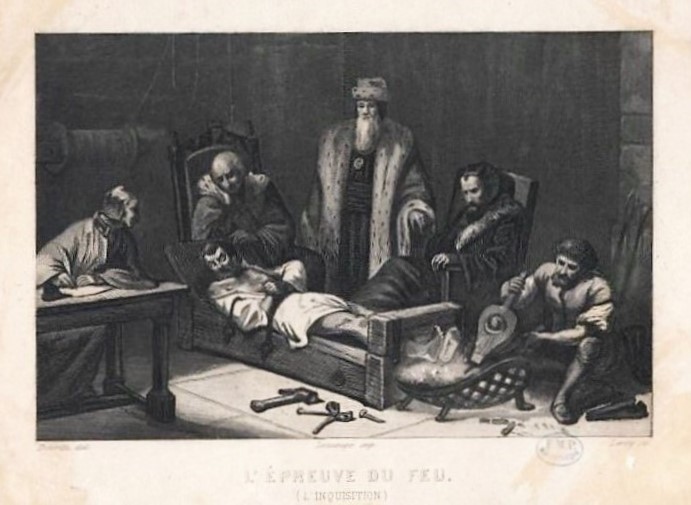
L’épreuve du feu (l’inquisition) by Devritz (painter) and Leroy (engraver) – date unknown source: BIU Santé The original meaning of the noun ordeal, from Old English ordāl, ordēl, is: an ancient test of guilt or innocence by subjection of the accused to severe pain, survival of which was taken as divine proof […]
Read MoreThe noun clue appeared as a variant spelling of clew, of same pronunciation. Not frequent until the 17th century, clue has become the prevailing form of the word in the sense of a fact or idea that serves to reveal something or solve a problem. The word is from Old English cliwen, cleowen, meaning a ball formed by winding yarn, twine or thread (it is still one […]
Read More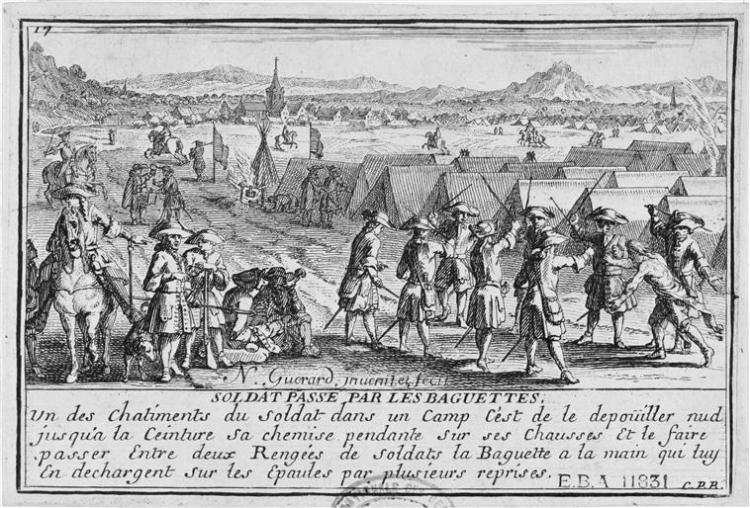
SOLDAT PASSE PAR LES BAGUETTES. Un des chatiments du soldat dans un camp c’est de le depouiller nud jusqu’a la ceinture sa chemise pendante sur ses chausses et le faire passer entre deux Rengées […]
Read MoreThe noun gooseberry denotes a round edible yellowish-green or reddish berry with a thin translucent hairy skin and the thorny shrub which bears these berries. Attested in the first half of the 16th century, it is probably based on Middle-French forms such as grosselle and groiselle (Modern French groseille), perhaps altered because of an unexplained […]
Read MoreThe word cheese is from Old English cēse, cȳse, of West-Germanic origin; it is related to its Dutch and German equivalents kaas and Käse respectively. Those words are ultimately derived from Latin caseus, cheese, which is also the origin of: – Spanish queso – Portuguese queijo – regional Italian cacio – Romanian: caș. Based on […]
Read MoreThe noun cruse denotes a small earthenware vessel for liquids. It is of Germanic origin and related to words such as Dutch kroes and Swedish krus, of same meaning. The expression widow’s cruse signifies an apparently small supply that proves inexhaustible. It is an allusion to the First Book of Kings, 17. The prophet Elijah has been fed by ravens and has drunk from a […]
Read MoreIn the chapter Our lunatic contributor of Words and names (1933), the British philologist Ernest Weekley (1865-1954) wrote: The correspondence columns of our middlebrow weeklies and of our two Sunday papers are the happy hunting-ground of the amateur etymologist. A few years ago he published the discovery that ‘nap,’ ‘a short sleep,’ was derived from Napoleon’s power of sleeping […]
Read More
image: nageur-sauveteur MEANINGS The noun starboard denotes the side of a ship or aircraft that is on the right when one is facing forward, while port denotes the opposing side. ORIGINS From the Germanic bases of the nouns steer and board, starboard, which appeared in Old English as steorbord, denotes literally the steer board, the steer side. This side of the ship […]
Read More word histories