The English poet John Taylor (1578-1653) wrote, in The great eater, of Kent, or Part of the admirable teeth and stomacks exploits of Nicholas Wood, of Harrisom in the county of Kent His excessiue manner of eating without manners, in strange and true manner described, by Iohn Taylor (1630): One Iohn Dale was too hard […]
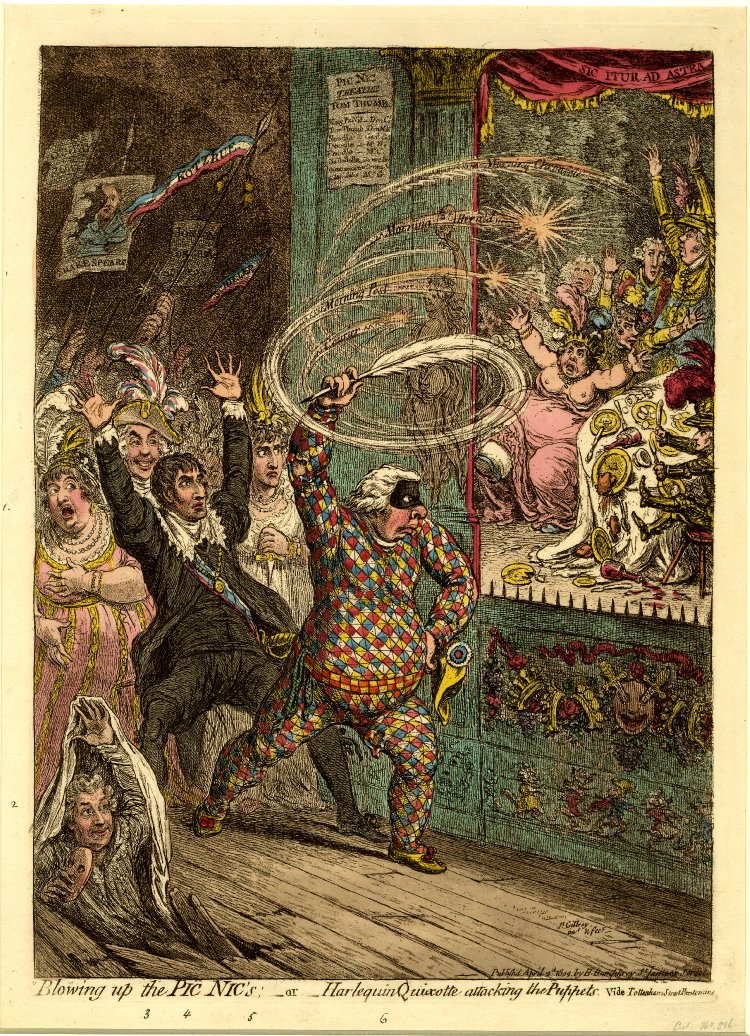
Blowing up the PIC NIC’s:—or—Harlequin Quixotte attacking the Puppets. Vide Tottenham Street Pantomime (1802), by James Gillray (1756-1815) — image: The British Museum MEANING a meal eaten outdoors ORIGIN This word is from French pique-nique, probably formed with reduplication from the verb piquer, to pick. (Similarly, pêle-mêle, the origin […]
the 1905 edition of Le Petit Larousse illustré, a French-language encyclopaedic dictionary published by the Éditions Larousse In 1890, Eugène Grasset (1845-1917) designed the image of la Semeuse (the Sower) blowing dandelion seeds, which accompanies the motto of the Éditions Larousse, Je sème à tout vent (I sow to the four winds). The word […]
The word tennis in its current sense is short for lawn tennis. The original form of tennis (known as real tennis to distinguish it from the later lawn tennis) was played with a solid ball on an enclosed court divided into equal but dissimilar halves, the service side (from which service was always delivered) and […]
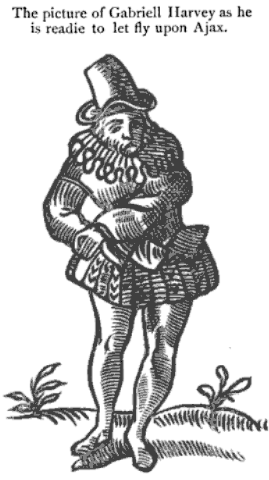
Caricature of Gabriel Harvey from Haue with you to Saffron-walden. Or, Gabriell Harueys hunt is vp (1596), by Thomas Nashe. Entitled The picture of Gabriell Harvey as he is readie to let fly upon Ajax, this caricature depicts him rushing to the toilet at the thought of Nashe’s publication. Ajax was a pun on […]
The phrase ‘a pretty kettle of fish’ originally referred to a net full of fish, which, when drawn up with its contents, is suggestive of confusion, flurry and disorder—‘kettle’ being a form of ‘kiddle’, a noun denoting a dam or other barrier in a river, with an opening fitted with nets to catch fish.
MEANING a young man paid or financially supported by a woman, typically an older woman, to be her escort or lover ORIGIN In English, gigolo originally denoted a professional male dancing-partner. One of its first users was the American novelist, short story writer and playwright Edna Ferber (1885-1968) in Gigolo, which was published in […]


 word histories