Australia, 1847—an odd-job man—‘wood-and-water’ alludes to the phrase ‘hewer of wood and drawer of water’, designating a labourer of the lowest kind—‘joey’ is perhaps the noun denoting a young kangaroo, and by extension anything young or small
UK, 1993—meaning: influenced or determined by a person’s locality or postal address—in phrases such as ‘postcode discrimination’—frequently with reference to the unequal provision of healthcare
USA, 1978—to commit suicide; to demonstrate unquestioning obedience or loyalty—alludes to a mass suicide, in 1978, by members of the Peoples’ Temple in Jonestown, Guyana, who drank a cyanide-laced drink thought to be similar to Kool-Aid
Australia, 1950—a traffic warden in the state of New South Wales—‘brown’ probably refers to the colour of those traffic wardens’ uniform—‘bomber’ may refer to the fact that many of those traffic wardens were originally war veterans; or perhaps to the Australian-English use of the noun ‘bomb’ for an old car
USA—‘squillion’ (1879): an extremely large but unspecified number, quantity or amount; arbitrary and humorous alteration of ‘million’, ‘billion’, etc.—‘squillionaire’ (1895): a person who has an extremely large but unspecified amount of money
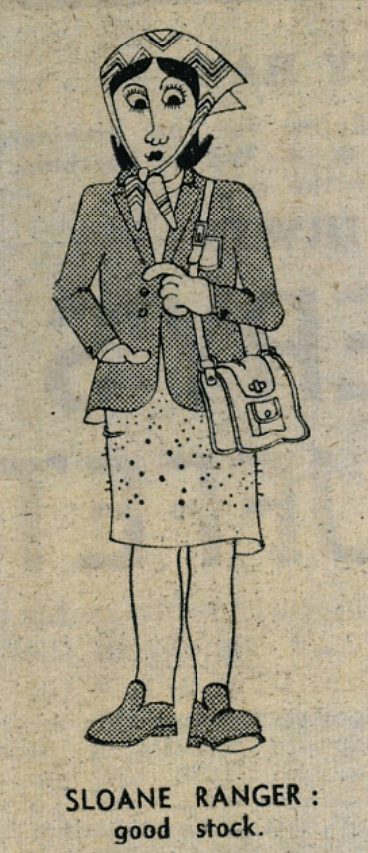
UK, 1975—an upper-class and fashionable, but conventional, young woman in London—blend of ‘Sloane Square’, the name of a square located in an affluent area of London, and ‘Lone Ranger’, the name of a well-known hero of western stories and films
UK, 1847—a fall in value, especially a reduction in wages—one of several expressions denoting the opposite in meaning of the noun qualified by the genitive case of ‘Irishman’—for example: ‘Irishman’s promotion’ (a demotion) and ‘Irishman’s hurricane’ (nautical: a flat calm)
a nickname given to London, which has, since the collapse of the Soviet Union, attracted Russian oligarchs—also used earlier in reference to Communism—modelled on Russian city names such as ‘Leningrad’ and ‘Stalingrad’
1762: the time of night when it is said that witches are active and supernatural occurrences take place—alludes to ‘the witching time of night’ in Shakespeare’s Hamlet—also (1985): the last hour of trading each month when exchange-traded stock options expire
Liverpool (Lancashire, north-western England), 1833—a speculating builder who constructs cheap houses, flats, etc., with materials of poor quality, for a quick profit—the origin of the element ‘jerry’ is unknown