The pharmaceutical firm Burroughs, Wellcome & Company was founded in London in 1880 by the American-born entrepreneurs Silas Burroughs (1846-95) and Henry Wellcome (1853-1936). They registered the name Tabloid (with capital initial) on 14th March 1884, as a trademark for concentrated drugs and medicines in tablet form. (It remains a proprietary name to this day.) The firm applied the […]
Politicians usually work with blue smoke and mirrors. What appears to be real is mostly an illusion, and what is unlikely turns out to be real. But sometimes, the blue smoke and mirrors don’t work. When you can’t produce a budget, you can’t call a news conference and pretend you did. from The News […]
Four’s a Crowd.—A merry, irresponsible farce that dips frequently into pure crazy comedy. For this they have chosen to give Errol Flynn and Olivia de Havilland a “break” from their usual story book hero and heroine types. These two lovely young people do very well, but I cannot think that crazy comedy suits them best. […]
The informal British phrase to chance one’s arm means to undertake something although it may be dangerous or unsuccessful. Its origin is unclear. The earliest use that I have found is from How our blue-jackets are fed, an article about the “diet of the British sailor at sea” published in The Weekly Telegraph […]
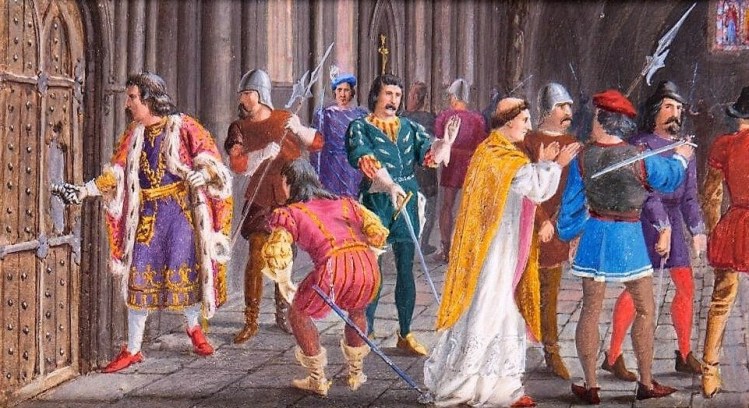
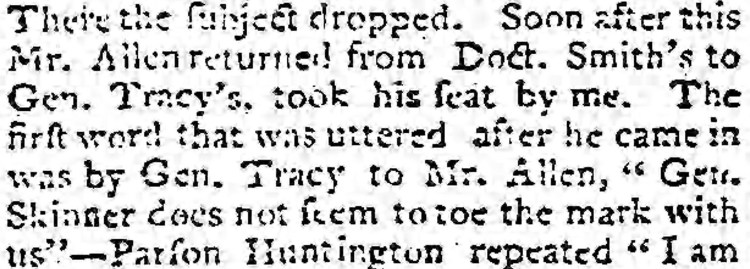
The phrase to toe the line means to accept the authority, policies or principles of a particular group, especially unwillingly. Its literal sense is to stand or crouch with the toes touching the line, especially at the start of a race or fight. The current meaning is an extension of a figurative usage, […]
The phrase not to give, care or be worth a tinker¹’s curse, cuss² or damn (or elliptically a tinker’s) is an intensification of not to give, care or be worth a curse, cuss or damn, with reference to the bad language reputedly used by tinkers. The low repute in which tinkers were held is also […]
The term thinking cap denotes an imaginary cap humorously said to be worn in order to facilitate thinking. The earliest instance that I have found is from the Western Carolinian (Salisbury, North Carolina) of 16th October 1821: We advise the editor to put his thinking-cap on, before he hazards another such assertion. The term also […]
Eastern Vaudeville Bans Unseemly Slang A general order has been sent out from the Keith office to all Keith, Moss and Proctor vaudeville houses, instructing resident managers to hereafter bar the use by artists of the current slang phrases, “That’s the Cat’s Meow,” “Cat’s Pajamas,” “Hot Dog,” “Hot Cat,” etc. This means the phrases […]
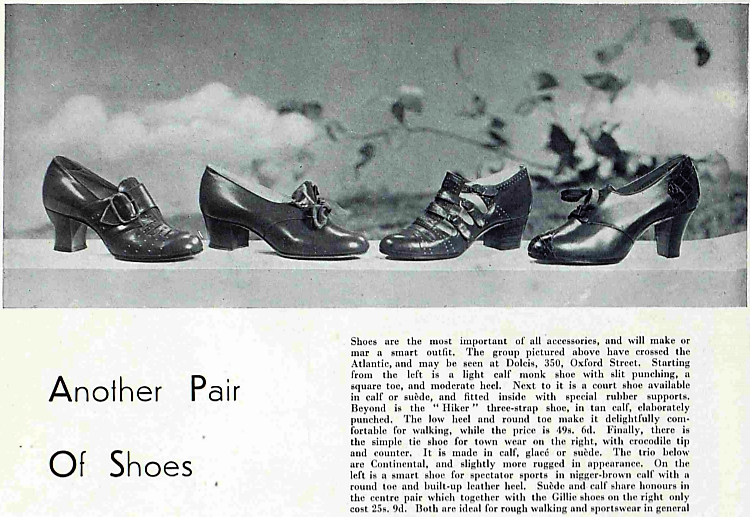
Another Pair Of Shoes Shoes are the most important of all accessories, and will make or mar a smart outfit. The group pictured above have crossed the Atlantic, and may be seen at Dolcis, 350, Oxford Street. Starting from the left is a light calf monk shoe with slit punching, a square toe, and […]
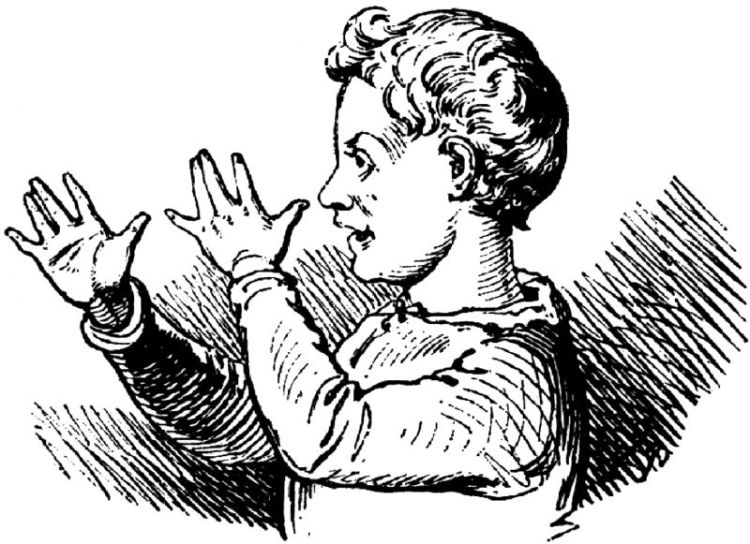
The phrase to cock (also to cut, to pull) a snook, or snooks, means: – literally: to make a gesture of derision by putting one’s thumb to one’s nose and outspreading the fingers; this gesture can be intensified by joining the tip of the little finger to the thumb of the other hand, whose fingers are […]





 word histories