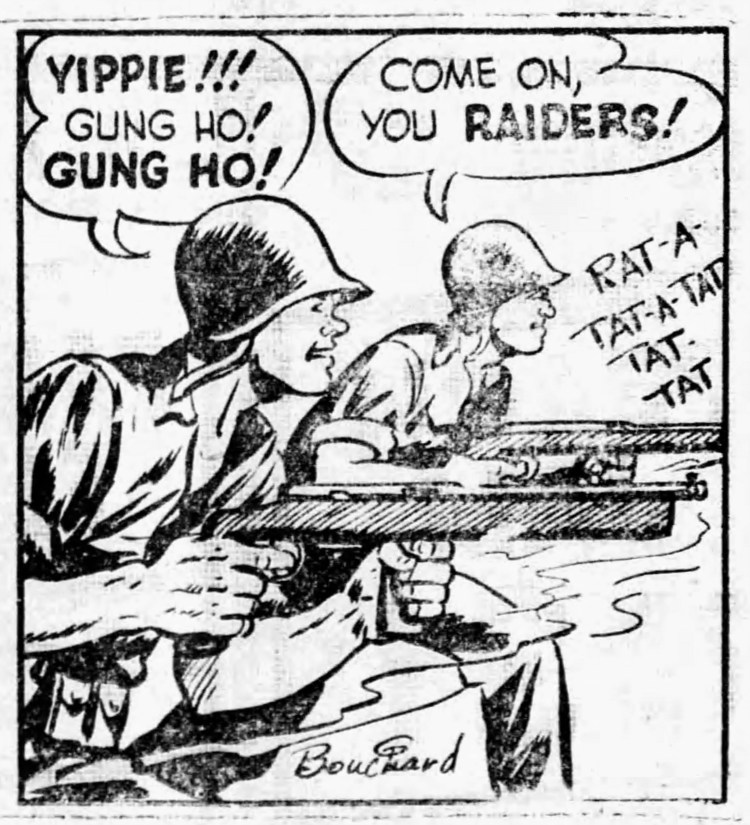
from Chinese ‘gōnghé’, short for ‘Zhōngguó Gōngyè Hézuò Shè’ (Chinese Industrial Cooperative Society)—interpreted as a slogan meaning ‘work together’ (USA, 1941)—adopted by Evans F. Carlson, commander of the 2nd Marine Raider Battalion (1942)
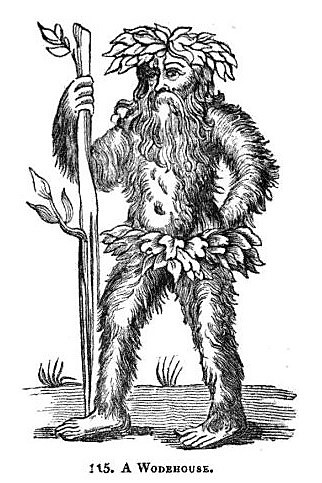
three meanings: 1/ in outdoor pageants: a man dressed in greenery, representing a wild man of the woods—2/ in inn names and signs: a forester—3/ in medieval English churches: a representation of a man’s face composed of, surrounded by, or sprouting foliage or branches
used to convey that something is unvaryingly familiar or drearily predictable—first recorded (USA, 1963) as the title of a song by Roger Kellaway, American jazz pianist and composer
first recorded in the United Kingdom in 1914, with reference to the civilizational implication of the German invasion of Belgium at the beginning of World War One; therefore, not first used by Orson Welles in Citizen Kane (1941)
UK, 1788—denotes an auction in which the price is lowered by stages until a buyer is found—said to have been invented by the Dutch specifically as the best solution to selling tulip bulbs
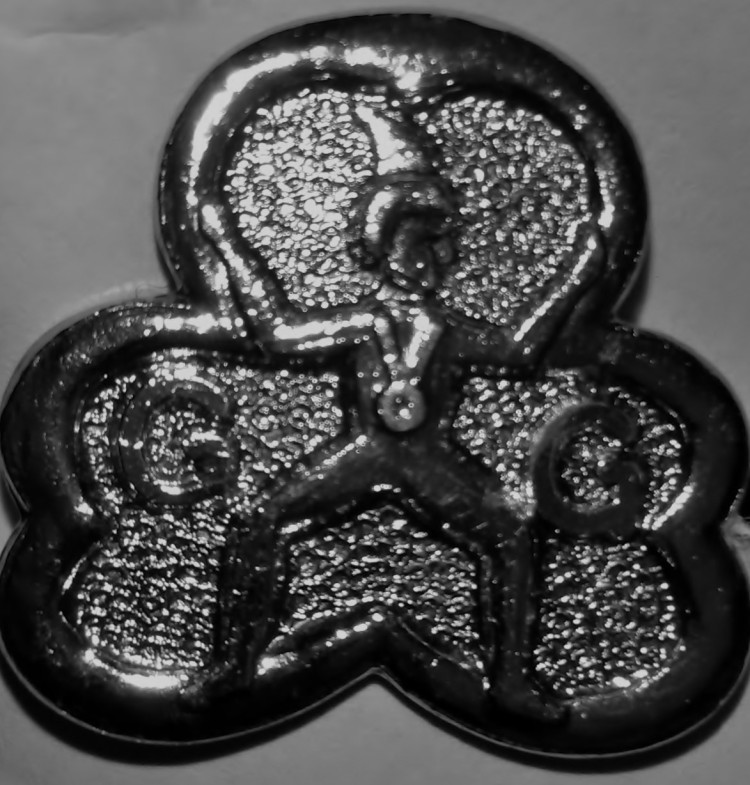
1916—from ‘brownie’, i.e. a benevolent elf that supposedly haunts houses and does housework secretly—not from the fact that the uniform of the junior Girl Scouts and Girl Guides is brown
1763 in French, 1798 in English—from the name of Étienne de Silhouette (1709-67), Controller-General of Finances in 1759—perhaps because he might have invented the portrait in profile obtained by tracing the outline of a head or figure by means of its shadow
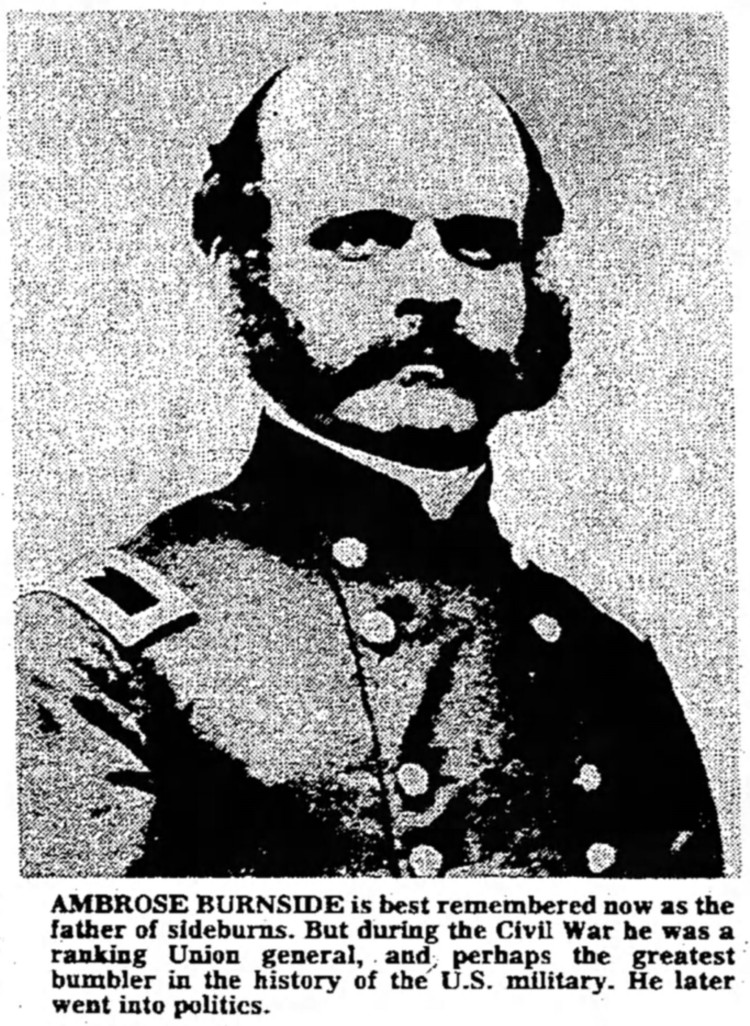
After Ambrose Burnside, Union general in the U.S. Civil War, ‘burnsides’ (1866) denotes thick side whiskers worn with a moustache and clean-shaven chin; on the pattern of ‘side whiskers’, it was altered to ‘sideburns’ (1875), itself altered to ‘sideboards’ (1882).
‘coward’—from Old-French ‘cuard’, probably referring to a frightened animal with its tail between its legs—from ‘cüe’ (Modern French ‘queue’), ‘tail’, and pejorative suffix ‘-ard’ (cf. ‘bastard’)—‘cowardy, cowardy custard’, alliterative nonsensical children’s phrase (19th century)
First recorded in The Leeds Mercury (Leeds, Yorkshire) of Friday 26 August 1938, the phrase ‘to use one’s loaf’ means ‘to use one’s common sense’. Here, ‘loaf’, a shortening of ‘loaf of bread’, is rhyming slang for ‘head’.



 word histories