Lancashire, England, 1833—a faggot, a meatball, “a compound of onions, flour, and small pieces of pork” (The Liverpool Echo, 20 August 1880)—probably one of the common dishes humorously named after daintier items of food
Liverpool, England, 1939—scouse without meat—“from the general early sense of ‘blind’ meaning ‘deficient’” (Liverpool English Dictionary)—‘scouse’, shortened form of ‘lobscouse’: “a dish of hashed meat stewed with potatoes and onions; an Irish stew” (English Dialect Dictionary)
literal meaning (1551): halfway across the sea—figurative meanings (1692): halfway towards a goal or destination, half through with a matter, halfway between one state and another—also (1699): half drunk
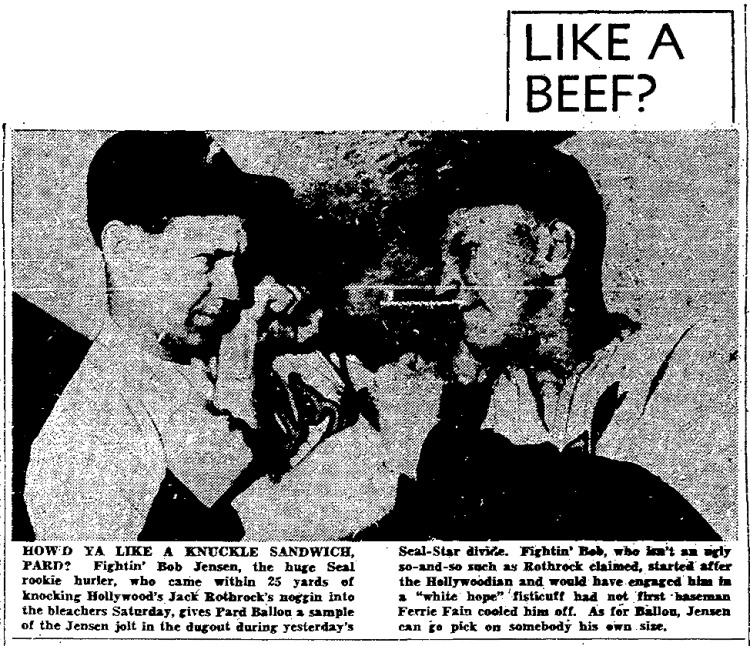
‘knuckle-sandwich’ USA, 1940—‘knuckle-butty’ UK, 1972—a punch to the mouth (or to the stomach)—the image is of a sandwich of knuckles being forced into the mouth (or into the stomach) of the person who is punched
UK, 1870—a very hard ship’s biscuit—refers to the fact that these sea-biscuits were particularly carried by Liverpool merchant ships; likens the shape and hardness of these sea-biscuits to those of pantiles, i.e. roofing tiles curved to an ogee shape
a dentist—World War Two—slang of the British armed forces—was soon adopted into (and came to be regarded as) Australian English—earlier synonyms: ‘fang-faker’ and ‘fang-wrencher’
UK, 1677—a bad cough indicative of impending death—with allusion to the churchyard as the site of burial, ‘churchyard’ has been used attributively of something indicative of, or associated with, (impending) death
USA, 1815—UK, 1822—to use long or obscure words in speech, especially excessively or unnecessarily; to speak grandiloquently or bombastically—1680 with reference to the Latin dictionary compiled by Ambrosio Calepino
UK, 1839—a Liverpudlian, especially as opposed to a Mancunian—from the 19th-century distinction between the Liverpudlians, who were involved in trading, and the Mancunians, who were involved in manufacturing
UK, 1975—old-fashioned; out of date—perhaps a humorous alteration of the adjective ‘antique’, perhaps punningly after the adjective ‘wacky’—or perhaps derived from ‘Ann Twack’, rhyming slang for ‘crap’

 word histories