The phrase ‘boys in the backroom’, or ‘backroom boys’, appeared in the 1920s as a U.S. political term denoting persons exercising a surreptitious influence. The Oxford English Dictionary is therefore mistaken in saying that it originally denoted, in 1941, persons engaged in research.
During the Cold War, especially in the context of a possible nuclear war, ‘better red than dead’ was used to warn against uncompromising opposition to communism, while ‘better dead than red’ was used to express unconditional opposition to communism.
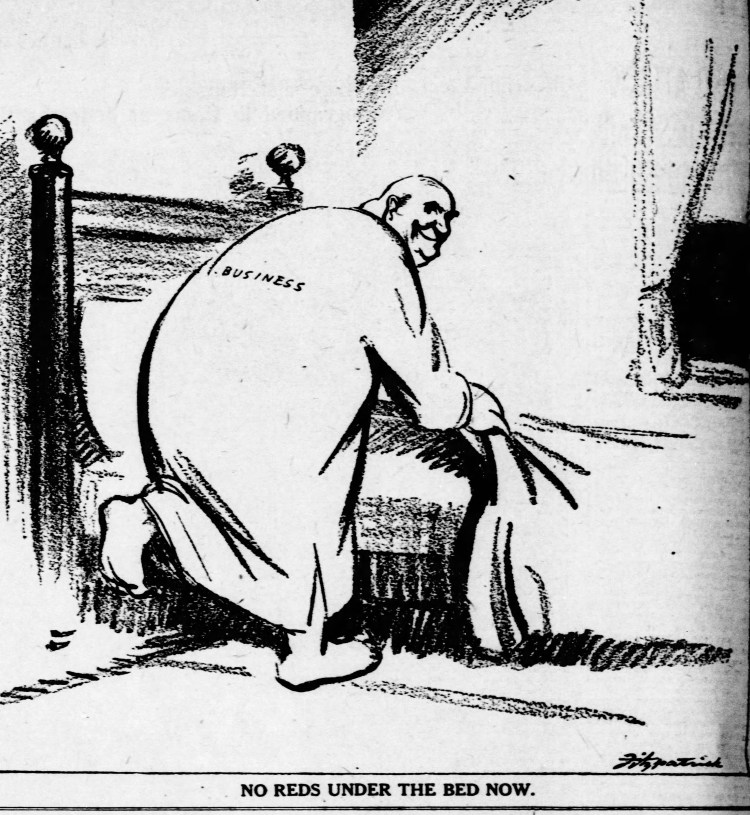
‘Reds under the bed’ and variants denoted an exaggerated or obsessive fear of the presence and harmful influence of communist sympathisers in a particular society, institution, etc. The earliest instance that I have found is from the Chicago Tribune of 28th September 1924.
U.S., 1903—originally used in the sense of ‘impractical scheme based on empty talk’, the element ‘blue sky’ meaning ‘unrealistic project’, and ‘hot air’ meaning ‘insubstantial claims’
A calque of German ‘blauer Montag’, ‘blue Monday’ originally denoted a Monday on which people chose not to work as a result of excessive indulgence over the course of the weekend. Under the influence of the adjective ‘blue’ in the sense ‘dismal’, it came to denote a Monday that is depressing or trying.
The noun red tape, meaning excessive bureaucracy or adherence to official rules and formalities, refers to the use of woven red tape to tie up bundles of legal documents and official papers; the literal meaning is first recorded in 1658, the figurative meaning in 1736.
some characteristic slang creations of the British, U.S. and French soldiers during World War One, as recorded in ‘Trench Talk’, published in Everybody’s Magazine (New York) of January 1918
USA, 1948—espresso coffee mixed with steamed milk—borrowed from Italian ‘cappuccino’, literally ‘Capuchin’, because the colour of this type of coffee resembles that of a Capuchin’s habit—cf. French ‘capucin’ (= ‘Capuchin’), a name for the hare, from the colour of the animal’s fur

 word histories