‘Hobby’, diminutive of ‘Hob’, pet form of ‘Robert’, was used to denote a small horse, hence a child’s toy with a horse’s head, hence a favourite occupation—cf. French ‘dada’, child’s word for horse, used to denote a favourite pastime
Twelfth Day denotes the twelfth day after Christmas, i.e. 6th January, on which the festival of the Epiphany is celebrated, and which was formerly observed as the closing day of the Christmas festivities. (Epiphany denotes the festival commemorating the manifestation of Christ to the Gentiles in the persons of the Magi; via Old-French and Anglo-Norman forms such as epyphane (Modern […]
USA, 1948—espresso coffee mixed with steamed milk—borrowed from Italian ‘cappuccino’, literally ‘Capuchin’, because the colour of this type of coffee resembles that of a Capuchin’s habit—cf. French ‘capucin’ (= ‘Capuchin’), a name for the hare, from the colour of the animal’s fur
The name ‘Indian summer’ (late 18th century) reflected the fact that to the Europeans living in the New World, this was a newly-discovered local phenomenon. But similar phenomena were already known in the Old World by various names.
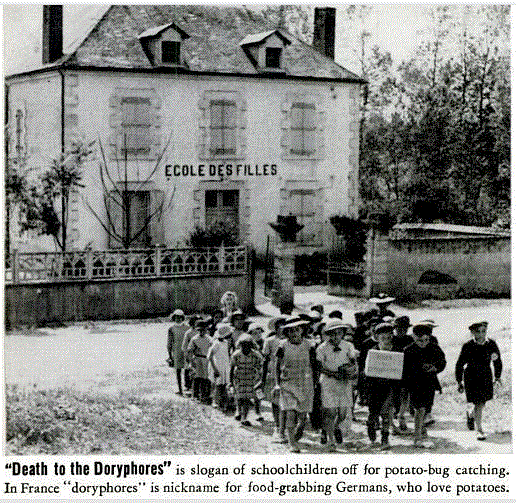
Greek ‘δορυϕόρος’ (‘doruphόros’) meant ‘spearman’; in French, ‘doryphore’ denotes the Colorado beetle and the German occupying forces during WWII; in English, it denotes a pedantic and annoyingly persistent critic.
19th century—The adverb ‘hands down’ originated in horse racing: a jockey who is winning comfortably is able to lower his hands and relax his hold on the reins.
Etymologically, ‘Shrovetide’ denotes the period during which it was customary to attend confession in preparation for Lent—but this period was also marked by feasting before the Lenten fast.
French—from the noun use of the Latin adjective ‘natalis’ (from Christian-Latin ‘natalis dies’, ‘day of birth’), denoting the festival of the nativity of Christ



 word histories