meaning and origin of ‘King Charles’s head’

obsession—from Dickens’s ‘David Copperfield’, in which Mr. Dick is unable to write his memoirs because of the intrusive image of King Charles the First’s head
Read More
“ad fontes!”
obsession—from Dickens’s ‘David Copperfield’, in which Mr. Dick is unable to write his memoirs because of the intrusive image of King Charles the First’s head
Read More
a game in which the player who has the role of Tom Tiddler defends his territory against the others, who try to steal his money—hence a source of easy money
Read More
coined by Charles Dickens in Nicholas Nickleby (1839) in a comic passage in which an insane speaker makes a series of nonsensical statements
Read More
‘like one o’clock’—mid 19th century, British: with speed, eagerness, energy; perhaps with reference to the lunchtime bustle in the northern manufacturing towns
Read MoreThe word ‘tyke’, a nickname for a person from Yorkshire, originally meant ‘mongrel’. The people from Yorkshire have adopted it as a term of self-reference.
Read More‘Mad as a hatter’ might be from ‘like a hatter’, an intensive phrase meaning ‘like mad’, perhaps related to the verb ‘hotter’, expressing motion and emotion.
Read More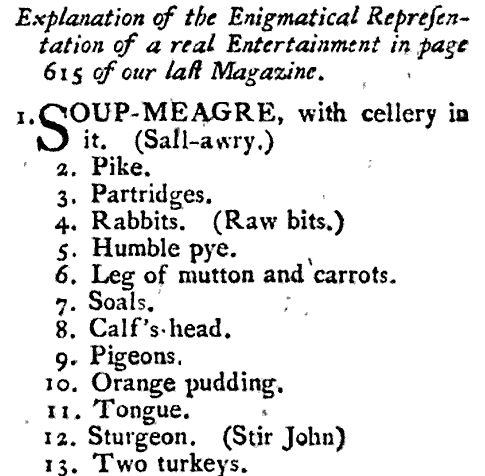
A puzzle published in The Hibernian Magazine, or, Compendium of Entertaining Knowledge (Dublin, Ireland) in 1774 punned on the humble of humble pie, which may indicate that the latter term was already used figuratively at that time. The following is from the October issue: […]
Read More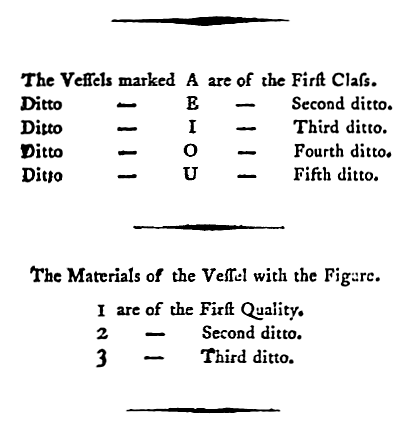
MEANING first class, outstanding ORIGIN Lloyd’s Register, historically Lloyd’s Register of Shipping, is an independent society formed in 1760 by a group of merchants operating at Lloyd’s coffee house in London, which surveys ships to ensure compliance with standards of strength and maintenance. The name also denotes an annual publication giving details […]
Read More
The phrase (as) happy (or jolly) as a sandboy means extremely happy or carefree—cf. also happy as a clam and happy as Larry. A sandboy was a boy hawking sand for sale. It seems that the earliest use of the word is The Rider and Sand-boy: a Tale, the title of a poem written by a certain Mr Meyler and published in Harvest-Home in 1805: […]
Read MoreMEANING a persistent or desperate hope that is unlikely to be fulfilled, a faint hope, a ‘hope against hope’ ORIGIN On the face of it, this is a curious expression, because the adjective forlorn does not normally mean faint but miserable, lonely, forsaken or sad. The current sense of forlorn hope derives […]
Read More word histories