The word cheese is from Old English cēse, cȳse, of West-Germanic origin; it is related to its Dutch and German equivalents kaas and Käse respectively. Those words are ultimately derived from Latin caseus, cheese, which is also the origin of: – Spanish queso – Portuguese queijo – regional Italian cacio – Romanian: caș. Based on […]
‘To fight like Kilkenny cats’ means ‘to engage in a mutually destructive struggle’.—from the tale of two cats fighting until only their tails remained (early 19th century), which was originally meant to be nothing but amusing nonsense.
In this expression, the noun poke denotes a bag, a small sack. It is from Anglo-Norman and Old Northern French forms such as poke and pouque, variants of the Old French forms poche and pouche — the last of which is the origin of English pouch. (Incidentally, English pocket is from Anglo-Norman poket, pokete, diminutive forms of poke.) The expression to buy a pig in a poke simply cautions against buying or accepting […]
The phrase to let the cat out of the bag means to disclose a secret. Although it is possible that to let the cat out of the bag originally referred to some specific allusion, such as a line in a play, that has now been lost, it is probable that this phrase is simply based on the […]
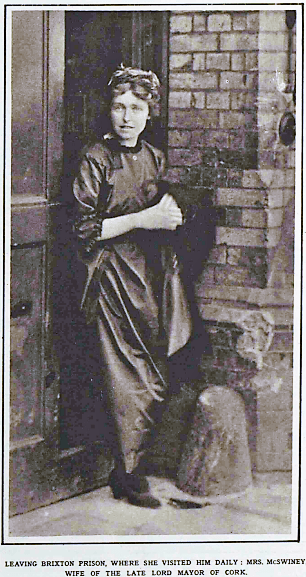
the Prisoners (Temporary Discharge for Ill-health) Act, 1913 – image: http://www.parliament.uk The Prisoners (Temporary Discharge for Ill-health) Act, 1913 was rushed through Parliament by Herbert Henry Asquith’s Liberal government in order to deal with the problem of hunger-striking suffragettes, who were force-fed, which led to a public outcry. The Act allowed for the […]
Executioner argues with King about cutting off Cheshire Cat’s head – illustration by John Tenniel (1820-1914) for Alice’s Adventures in Wonderland (1865) The executioner’s argument was, that you couldn’t cut off a head unless there was a body to cut it off from. The phrase a cat may look at a king means even a person of low […]
Tip-Cat in A Little Pretty Pocket-Book, Intended for the Instruction and Amusement of Little Master Tommy, and Pretty Miss Polly (1787 edition) The phrase to see which way the cat jumps means to see what direction events are taking before committing oneself. One of its earliest instances is from The Berkshire Chronicle […]
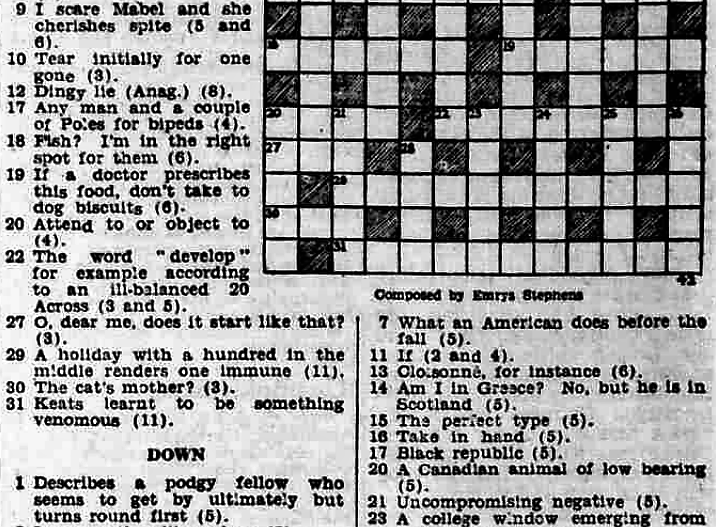
crossword in The Yorkshire Post and Leeds Mercury of 23rd January 1950 30 across: The cat’s mother? (3). The phrase who’s ‘she’—the cat’s mother? and variants are said to a person, especially a child, who uses the feminine third person singular pronoun impolitely or with inadequate reference. The earliest use of the phrase that I found is from The White […]
The phrase like a cat on hot bricks and its American-English equivalent like a cat on a hot tin roof mean very agitated or anxious. An earlier form of the phrase was recorded by the English naturalist and theologian John Ray (1627–1705) in A Collection of English Proverbs (2nd edition – 1678): To go like […]
The phrase not a cat in hell’s chance means no chance at all—synonyms: a snowball’s chance (in hell) and a Chinaman’s chance. It is a shortening of the more explicit no more chance than a cat in hell without claws. The earliest instance of this phrase that I have found is from Jackson’s Oxford Journal of 29th September 1753: Poor […]




 word histories