‘to go bald-headed’ (to rush without care or caution)
first recorded in The Biglow Papers (1848), by American author James Russell Lowell—based on the notion of leaving one’s hat behind in a rush of impetuosity
Read More
“ad fontes!”
first recorded in The Biglow Papers (1848), by American author James Russell Lowell—based on the notion of leaving one’s hat behind in a rush of impetuosity
Read MoreUSA, 1914—‘ailurophile’: a cat lover—‘ailurophobe’: opposite sense—based on ancient Greek ‘aílouros’, ‘cat’, perhaps from ‘aiόlos’, ‘swift’, and ‘ourá’, ‘tail’, the cat being perhaps so called on account of the swift movement to and fro of its tail
Read Morefrom the notion that even a dead cat will bounce if dropped from a sufficient height—UK, 1981: a rapid fall in the stock market with hardly any reaction—USA, 1985: a rapid but short-lived recovery in the stock market after a sharp fall—hence, 1992: any spurious success
Read MoreUSA, 1950s—The noun ‘doggy (or doggie) bag (or pack)’ denotes a bag, provided on request by the management of a restaurant, in which a diner may take home any leftovers; apparently, these leftovers were originally intended for the diner’s pet dog.
Read More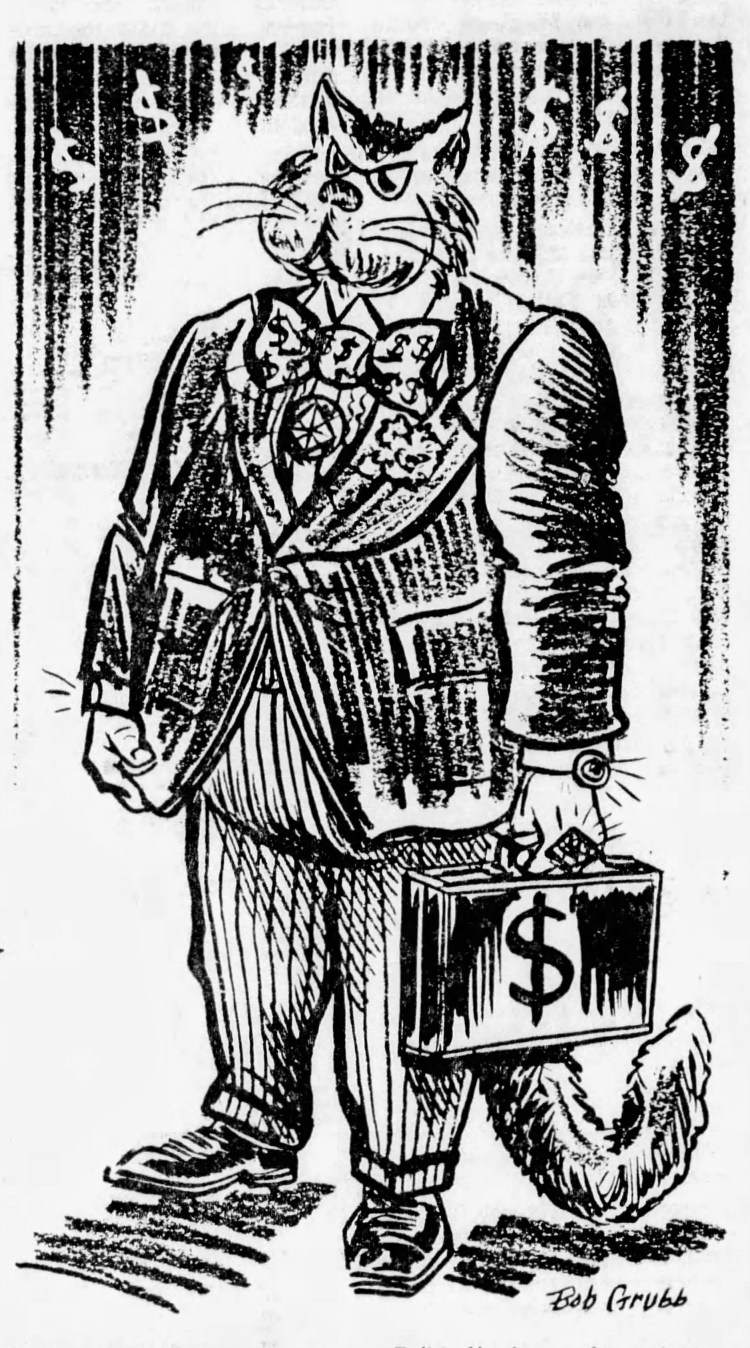
Of American-English origin, the slang term fat cat denotes a wealthy, influential person, especially one who is a heavy contributor to a political party or campaign. The earliest occurrence that I have found is from an article published in The Sun (Baltimore, Maryland) of 1 November 1925.
Read More‘queen’s’, or ‘king’s’, ‘cushion’: a seat made by two people who cross arms and hold each other’s hands to form a support for another person—Scotland and northern England, 19th century
Read MoreGreek ‘skíouros’, ultimate origin of ‘squirrel’: folk-etymologically interpreted as meaning ‘shadow-tailed’ because when the animal sits erect, it raises its tail up against its back and over its head as if to shade itself
Read Moreremarks on English phrases (‘to rain cats and dogs’, ‘tit for tat’, ‘the devil to pay’, etc.) – from Notes and Queries (London), 9th November 1861
Read More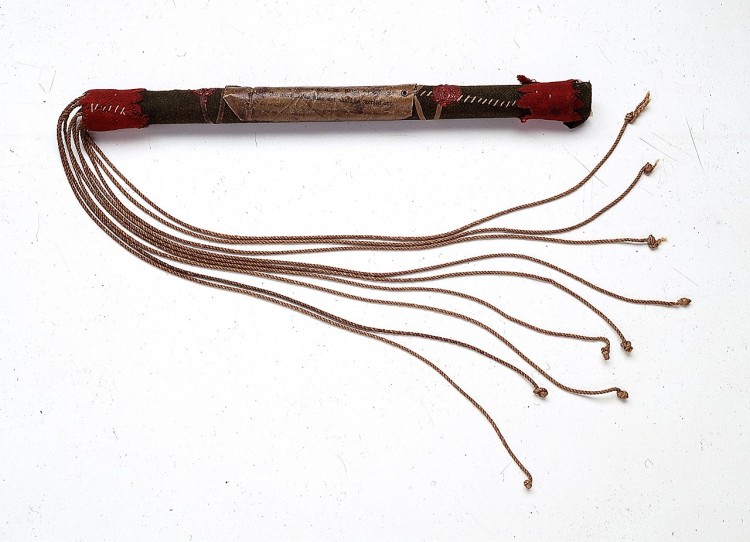
cat-o’-nine-tails (1866-79) – photograph: National Maritime Museum The noun cat-o’-nine-tails denotes a rope whip with nine knotted cords, formerly used, especially at sea, to flog offenders. This instrument of punishment was authorised in the British navy and army until 1881—cf. also to run the gauntlet. The word is first recorded in Love for […]
Read More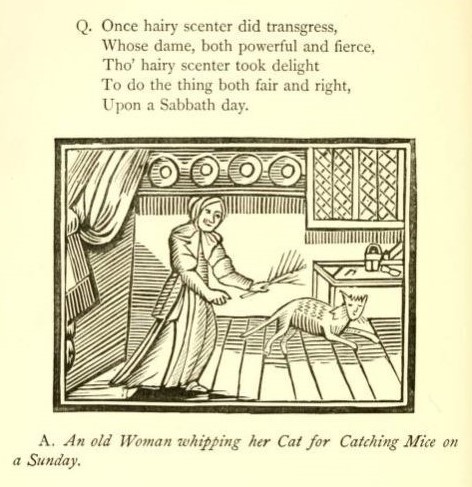
Q. Once hairy scenter did transgress, Whose dame, both powerful and fierce, Tho’ hairy scenter took delight To do the thing both fair and right, Upon a Sabbath day. A. An old Woman whipping her Cat for Catching Mice on a Sunday. from The True Trial […]
Read More
