notes on ‘England and America are two countries separated by the same language’

USA, 1942—has often been attributed to the Irish author George Bernard Shaw—has occasionally been applied to the relations between Australia and the USA
Read More
“ad fontes!”
USA, 1942—has often been attributed to the Irish author George Bernard Shaw—has occasionally been applied to the relations between Australia and the USA
Read MoreUK, 1871—a paper bag, balloon, etc., filled with flour and thrown or dropped such that it bursts and disperses its contents over the target on impact, usually as a prank or as part of a protest or public demonstration
Read MoreUK, 1884—‘what a surprise!’—a borrowing from French—chiefly used ironically, to imply that a situation or event is unsurprising, typical or predictable
Read MoreU.S. criminals’ slang, 1915—to reveal the truth about something secret or private
Read Morea cake made with the ingredients available during wartime—first used during the First World War (1914-1918)—came back into usage during the Second World War (1939-1945)
Read MoreAustralia & USA, 1850—a married woman whose husband has left to prospect for gold in California
Read More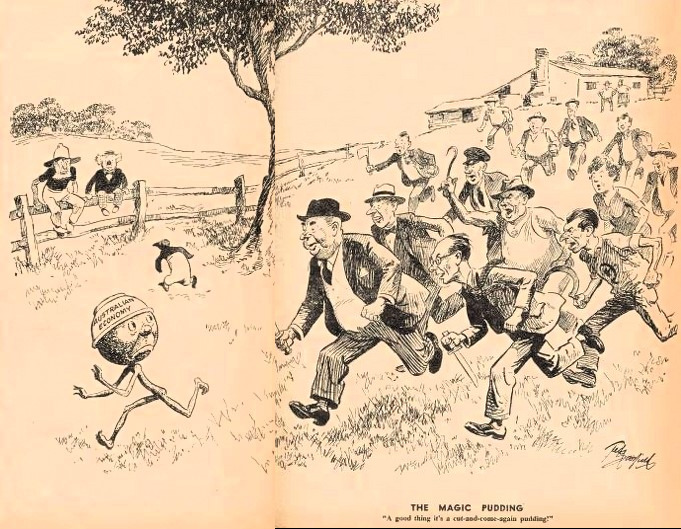
Australia, 1934—an inexhaustible supply of something, especially money—alludes to The Magic Pudding (1918), by Norman Lindsay, in which a pudding instantly renews itself as it is sliced or eaten into
Read MoreNew Zealand, 1917—a mess, a muddle; something unattractive or unappetising—alludes to the jumbled nature of a pig’s meal
Read MoreUK, 1911—a sharp blow to the back of the neck—refers to the practice of killing rabbits in this way, and originated in boxing—Australia, 1913: ‘rabbit killer’, also ‘rabbit-killer punch’
Read Morea person exercising an insidious or corrupting influence, especially over a ruler, government, etc.—UK, 1917—refers to Grigori Efimovich Rasputin (circa 1869-1916), mystic and influential favourite at the court of Tsar Nicholas II
Read More word histories