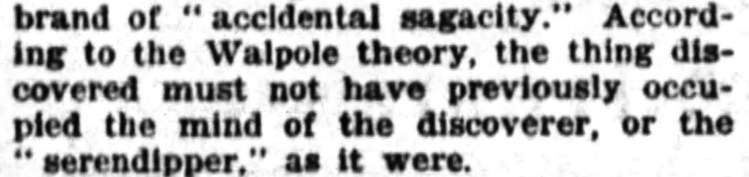
The noun serendipity denotes the faculty of making by accident discoveries that are both fortunate and unexpected. (It has been borrowed into Spanish as serendipia, into Italian as serendipità, and into French as sérendipité.) It was coined by the English writer and politician Horace Walpole (1717-97). In a letter that he wrote to his friend Horace Mann […]
In cricket, from the resemblance between the figure 0 and a duck’s egg, the term duck’s egg denotes the zero (i.e. 0) placed against a batsman’s name in the scoring sheet when he fails to score. This was explained in Very Hard Cash (1863), a novel by the English novelist and playwright Charles Reade (1814-84): […]
The name Hogs Norton, also Hog’s Norton and Hogsnorton, denotes a fictional town renowned for its uncultured and boorish inhabitants. It has often been used in depreciative phrases suggesting that someone is a native or inhabitant of this town. These phrases have variously associated the name: – with present-day Hook Norton, a town in Oxfordshire […]
A blend of turkey, duck and chicken, the noun turducken designates a poultry dish consisting of a boned chicken inside a boned duck which is in turn placed inside a partially boned turkey, along with seasoned stuffing between the layers of meat and in the central cavity, the whole typically being cooked by roasting. It […]
Eastern Vaudeville Bans Unseemly Slang A general order has been sent out from the Keith office to all Keith, Moss and Proctor vaudeville houses, instructing resident managers to hereafter bar the use by artists of the current slang phrases, “That’s the Cat’s Meow,” “Cat’s Pajamas,” “Hot Dog,” “Hot Cat,” etc. This means the phrases […]
The phrase to cock (also to cut, to pull) a snook, or snooks, means: – literally: to make a gesture of derision by putting one’s thumb to one’s nose and outspreading the fingers; this gesture can be intensified by joining the tip of the little finger to the thumb of the other hand, whose fingers are […]
The phrase cock-and-bull story denotes an implausible story used as an explanation or excuse. The French expression sauter du coq à l’âne, literally to jump from the cock to the (male) ass, means to skip from one subject to another, the image being that incoherent talking is like switching abruptly from the topic of the cock to that of […]
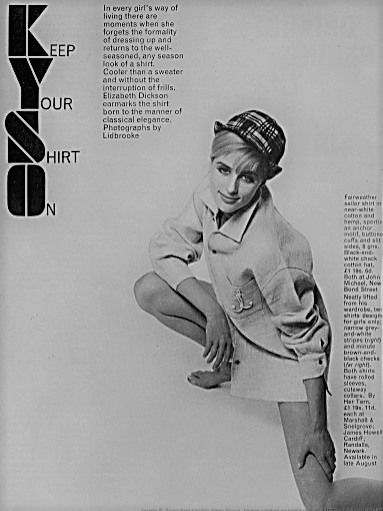
Keep your shirt on In every girl’s way of living there are moments when she forgets the formality of dressing up and returns to the well-seasoned, any season look of a shirt. Cooler than a sweater and without the interruption of frills. Elizabeth Dickson earmarks the shirt born to the manner of classical elegance. advertisement […]
The word daisy is from Old English dæges éage, meaning day’s eye. This name alludes to the fact that the flower of this plant opens in the morning and closes at night, as the human eye does. Perhaps its petals, which close over its bright centre at the end of the day, were also thought to resemble human eyelashes. But the […]
Literally denoting a mouse which lives in a church, the noun church mouse has long been used figuratively and allusively of a person likened to such a mouse, in terms of its proverbial attributes, especially in being impoverished or quiet. For example, the Anglo-Welsh historian and political writer James Howell (circa 1594-1666) recorded the following […]


 word histories