Australia, 1930—a humorous extended form of ‘flat out’, meaning ‘with the maximum speed or effort’ (apparently with wordplay on ‘flat out’, meaning ‘lying stretched out’)—has occasionally been used in the opposite sense
Australia, 1972—a person, usually a man, who, in spite of a superficial smartness, is untrustworthy—‘rat’ refers to a deceitful or disloyal man—the image is that, despite the gold tooth, a rat’s basic nature cannot change
Australia, 1928—an outstandingly good person or thing—variant of the synonymous jocular expressions, of U.S. origin, based on various parts of animals’ real or fanciful anatomy and other attributes, such as ‘the bee’s knees’ and ‘the cat’s whiskers’
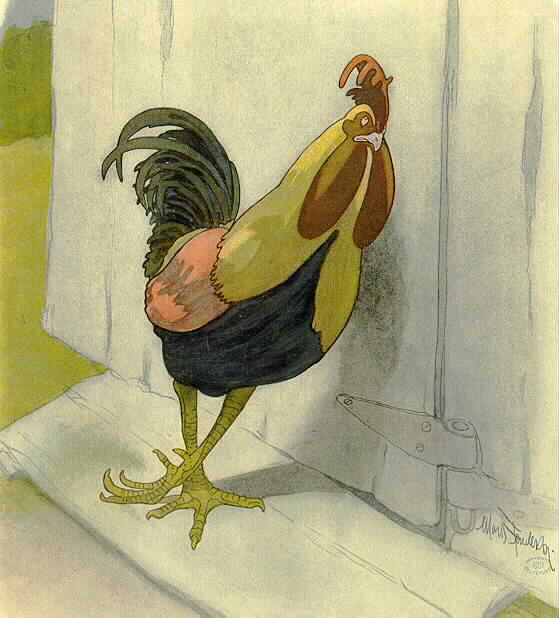
USA 1907—used of the inanity of life and of the transitoriness of success—originated in the captions to a cartoon known as ‘The Dejected Rooster’, by Mark Fenderson, published by the weekly magazine Life (New York City) in 1907
USA, 1893—utterly despicable—jocular extension of ‘lower than a snake’—refers to the use of ‘low’ to mean ‘despicable’, and to the use of ‘snake’ to denote ‘a treacherous or deceitful person’
USA, 1982—a catchy song or melody that keeps repeating in one’s mind, especially to the point of irritation—loan translation from German ‘Ohrwurm’—original meaning (1598): an earwig
There have been, since the early 20th century a number of colourful variants of the U.S. phrase ‘as busy as a one-armed paperhanger’—for example, in Australian English, ‘as busy as a one-armed taxi-driver with crabs’ and ‘as busy as a brickie in Beirut’.
Australia, 1879—With reference to the supposed destruction of the brain by white ants (i.e., termites), the plural noun ‘white ants’ is used of loss of sanity, sense or intelligence. (The singular noun ‘white ant’ occasionally occurred in early use.)
The obsolete Australian-English phrase to jump one’s horse over the bar, and its variants, meant to sell a horse for liquor. The following definition is from an unpublished manuscript entitled Materials for a dictionary of Australian Slang, collected from 1900 to 1910, by Alfred George Stephens and S. J. O’Brien—as quoted by Gerald Alfred Wilkes (1927-2020) in A […]
Australia, 1912—of a racehorse: to perform very badly—also in extended use and in the opposite sense—from ‘hairy goat’ (1894): a racehorse which performs badly—synonym ‘hairy dog’ (1908)

 word histories