The proper name Guy is derived, via French, from the Old German Wido, either from wit, meaning wide, or from witu, wood. Wido has become Guy in French because in words of Germanic origin, when initial, the labio-velar approximant /w/ has regularly become the velar /g/. For instance, in the French noun loup-garou, the element garou corresponds to English werewolf—in fact, loup was added when the […]
The proverb you can’t have your cake and eat it (too) means you can’t enjoy both of two desirable but mutually exclusive alternatives. It made more sense in its early formulations, when the positions of have and eat had not been reversed. It is first recorded in A dialogue conteinyng the nomber in effect of […]
The word Mayday, which dates from 1923, is used as an international radio distress signal, especially by ships and aircraft. It was supposedly coined by Frederick Stanley Mockford (1897-1962), a senior radio officer at London’s Croydon Airport, but this has not been substantiated: the fact that this story has often been repeated gives it a semblance […]
MEANING foolish or fanciful talk, ideas, plans, etc. ORIGIN It is a shortening of moonshine in the water, meaning appearance without substance, something unsubstantial or unreal. In this phrase, moonshine means moonlight. The 15th-century correspondence between members of the Paston family of Norfolk gentry, and with others connected with them in England, […]
This Latin expression is composed of virtus, virtue, and dormitiva, feminine of dormitivus, dormitive. It first appeared in the following lines in dog Latin of Le Malade imaginaire (The Imaginary Invalid – 1673), in which the French playwright Molière (Jean-Baptiste Poquelin – 1622-73) satirised the circular explanations sometimes used in early medicine: (original edition) BACHELIERVUS. Mihi à docto Doctore Domandatur causam & rationem, […]
The phrase trick or treat is a traditional formula used at Hallowe’en by children who call on houses threatening to play a trick unless given a treat or present. In early use, the phrase was also tricks or treats, treat or trick, and variants. This phrase seems to have originated in Ontario (capital: Toronto), a province of […]
The word kidney, which is attested around 1325, is of unclear origin. The second element of the Middle-English form kidenei, plural kideneiren, is apparently ey, plural eyren, meaning egg (cf. German Eier, literally eggs, used to mean testicles). The first element remains uncertain; it is perhaps identical with cud. The Anglo-Saxon name for kidney was […]
James Crichton of Clunie (circa 1560-1582) was a Scottish prodigy of intellectual and knightly accomplishments, and the epithet admirable became traditionally applied to him. The Scottish scholar John Johnston (circa 1565-1611) used the Latin adjective admirabilis in Heroes ex omni historia Scotica lectissimi (1603), a collection of biographies and eulogies in elegiac couplets of great […]
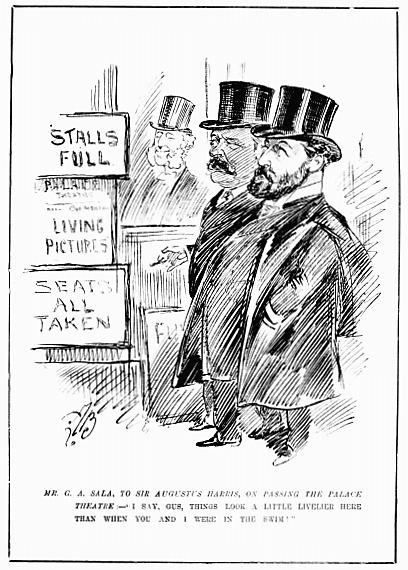
G. A. SALA, TO SIR AUGUSTUS HARRIS, ON PASSING THE PALACE THEATRE:—“I SAY, GUS, THINGS LOOK A LITTLE LIVELIER HERE THAN WHEN YOU AND I WERE IN THE SWIM!” — from The Entr’acte and Limelight (London) of 10th March 1894 (Augustus Harris (1825-73) was a British actor and theatre manager. George Augustus Sala (1828-95), was an […]
MEANING a single fortunate event doesn’t mean that what follows will also be good ORIGIN The annual migration of swallows to Europe from southern climes at the end of winter was the subject of a proverb in Ancient Greece: μία χελιδὼν ἔαρ οὐ ποιεῖ, in which ἔαρ means spring; it is found […]

 word histories