The phrase (as) happy as a clam means well pleased, quite contented—cf. also happy as a sandboy and happy as Larry. In Dictionary of English Phrases (2008), Robert Allen explains: This American simile is more understandable in its full form, happy as a clam in high water (or at high tide). In these conditions, clams […]
The phrase (as) happy (or jolly) as a sandboy means extremely happy or carefree—cf. also happy as a clam and happy as Larry. A sandboy was a boy hawking sand for sale. It seems that the earliest use of the word is The Rider and Sand-boy: a Tale, the title of a poem written by a certain Mr Meyler and published in Harvest-Home in 1805: […]
According to the post-biblical Christian tradition, the apple is the fruit of the tree of knowledge of good and evil eaten by Adam and Eve in the Garden of Eden in defiance of God’s commandment. However, in the Book of Genesis, the type of fruit eaten by Adam and Eve is not specified. In the King James Version (1611), the two […]
The phrase there’s no, or little, or not much, love lost between means there is mutual dislike between. This expression is ambiguous, and has also been used to mean there is mutual affection between. Both senses are found in Clarissa; or, The history of a young lady (1748), an epistolary novel by the English author and printer Samuel Richardson (1689-1761): – ‘positive’ sense: “Why, […]
The phrase tit for tat means an equivalent given in return or retaliation. The expression seems to be a variation of the obsolete and more comprehensible tip for tap, in which both tip and tap meant a light but distinct blow, stroke, hit. The phrase therefore meant blow for blow. The words tip and tap first appeared combined in Fortunes Stabilnes, by Charles d’Orléans (1394-1465). Context: the letter patent […]
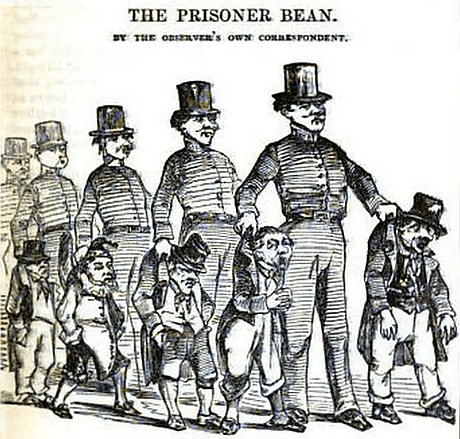
The term human bean is a humorous alteration or mispronunciation of human being, frequently used as part of an extended pun relating to beans. It is first recorded in Punch, or The London Charivari (1842): This little wretch is exciting the most intense interest, (Faugh!) and we have bribed the authorities in all directions to obtain information regarding him. It […]
The verb nail is used to mean to expose or reveal the falsehood of an allegation, assertion, etc., especially to prevent further dissemination. This use is first recorded in An Oration delivered at the Celebration in Philadelphia of the 106th Anniversary of the Birthday of Thomas Paine, by John Alberger, published in The North American […]
The noun myrmidon denotes a follower or subordinate of a powerful person, typically one who is unscrupulous or carries out orders unquestioningly. This word first appeared in the plural forms Mirmydanes and Murmindones in The Laud Troy book, a poem about the siege of Troy composed around 1400. It is from the classical Latin plural […]
The phrase to miss the bus, or the boat, etc., means to be too slow to take advantage of an opportunity. In A Concise Dictionary of Phrase and Fable (1993), B. A. Phythian explained: This expression is said to originate in an Oxford story of the 1840s about John Henry Newman, fellow of Oriel College, […]
“HUNS KILL WOMEN AND CHILDREN!” “TELL THAT TO THE MARINES!” First-World-War US recruiting poster by James Montgomery Flagg image: Disappearing Idioms This poster, which attracted a great deal of attention, portrays an angry-looking young man in the act of pulling off his coat as though he were anxious to get into a fight. The […]



 word histories