Tip-Cat in A Little Pretty Pocket-Book, Intended for the Instruction and Amusement of Little Master Tommy, and Pretty Miss Polly (1787 edition) The phrase to see which way the cat jumps means to see what direction events are taking before committing oneself. One of its earliest instances is from The Berkshire Chronicle […]
The proper noun Disgusted (with initial capital D) was originally used as a self-designation by a member of the public writing anonymously to a newspaper in order to express outrage about a particular issue—cf. also meaning and history of ‘to write to The Times about it’. The earliest instance of this noun that I have found is […]
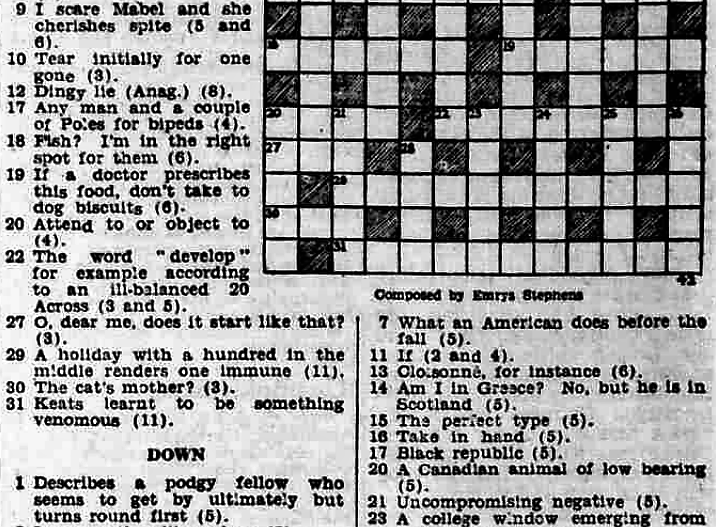
crossword in The Yorkshire Post and Leeds Mercury of 23rd January 1950 30 across: The cat’s mother? (3). The phrase who’s ‘she’—the cat’s mother? and variants are said to a person, especially a child, who uses the feminine third person singular pronoun impolitely or with inadequate reference. The earliest use of the phrase that I found is from The White […]
It is often said that the abbreviated form Xmas “takes the Christ out of Christmas”, but this is not the case. For example, a certain Reverend Thomas Eyre wrote to a Doctor Poynter on 25th January 1807: My Lord,—Your much esteemed favour of the 5th of December I received the day after Xmas. The noun Christ is from the Latin Christus, […]
The proverb every cloud has a silver lining means that every difficult or sad situation has a comforting or more hopeful aspect, even though this may not be immediately apparent—cf. also the pessimistic reversal every silver lining has a cloud. In 1840, the Irish novelist known as Mrs S. C. Hall (Mrs Samuel Carter Hall, […]
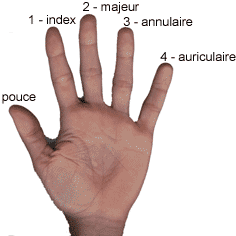
In the Etymologies (Etymologiarum sive Originum libri viginti), compiled between around 615 and the early 630s in the form of an encyclopaedia arranged by subject matter, St Isidore (circa 560–636), bishop of Seville and Doctor of the Church, wrote the following about the names of the fingers (the original Latin words are […]
The phrase like a cat on hot bricks and its American-English equivalent like a cat on a hot tin roof mean very agitated or anxious. An earlier form of the phrase was recorded by the English naturalist and theologian John Ray (1627–1705) in A Collection of English Proverbs (2nd edition – 1678): To go like […]
The phrase not a cat in hell’s chance means no chance at all—synonyms: a snowball’s chance (in hell) and a Chinaman’s chance. It is a shortening of the more explicit no more chance than a cat in hell without claws. The earliest instance of this phrase that I have found is from Jackson’s Oxford Journal of 29th September 1753: Poor […]
The Italian noun gianduia (improperly gianduja) appeared in the 19th century to denote a soft confection made with chocolate and ground hazelnuts, first produced in Turin, the capital of Piedmont, a region in north-western Italy, in the foothills of the Alps. (The Italian name is Piemonte, from piede, foot, and monte, mount.) This confection was […]
The phrase wouldn’t say boo to a goose is used to emphasise that someone is very timid. Here, boo is not an expression of disapproval but a later form of bo, an exclamation intended to frighten. In Notes and Queries of 10th September 1870, the English philologist Walter William Skeat (1835-1912) wrote: “Cry Bo to […]




 word histories