Several colloquial phrases associate daisies with being dead: under the daisies, which means dead and buried, to push up (the) daisies and to turn one’s toes up to the daisies, which mean to be in one’s grave, to be dead. The Clare Journal, and Ennis Advertiser (Ireland) of 9th August 1838 published this poem: […]
The phrase the cup that cheers but not inebriates and its variants refer to tea as a drink which invigorates a person without causing drunkenness. It is from The Winter Evening, the fourth book of The Task. A Poem, in six Books (1785), by the English poet and letter-writer William Cowper (1731-1800): Now stir the fire, and close the […]
The phrase curate’s egg means something that has both good and bad characteristics or parts. This phrase was popularised by True Humility, a cartoon by George du Maurier *, published in Punch, or the London Charivari (London, England) of Saturday 9th November 1895. This cartoon depicts a meek curate who, having been served a stale egg while […]
The phrase hell hath no fury like a woman scorned is a misquotation from The mourning bride, a tragedy by the English playwright and poet William Congreve (1670-1729), produced and published in 1697: Vile and ingrate! too late thou shalt repent The base Injustice thou hast done my Love. Yes, thou shalt know, spite of thy past Distress, […]
Literally denoting a mouse which lives in a church, the noun church mouse has long been used figuratively and allusively of a person likened to such a mouse, in terms of its proverbial attributes, especially in being impoverished or quiet. For example, the Anglo-Welsh historian and political writer James Howell (circa 1594-1666) recorded the following […]
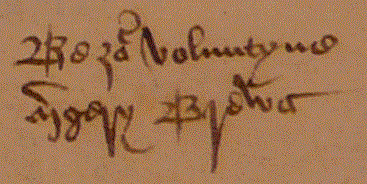
There are two Valentines, both Italian, one a priest and the other a bishop, who were martyred and used to be commemorated in the Roman Catholic calendar on 14th February. However, they have no romantic associations and the modern customs linked with St Valentine’s Day arise from a tradition according to which it is the day when the […]
In the United Kingdom, especially in the mid-1950s, a Teddy boy was a young man characterised by a style of dress and appearance held to be characteristic of Edward VII’s reign (1901-10), typically a long velvet-collared jacket, drainpipe trousers and sideburns (Teddy is a pet form of Edward (VII)). The term first appeared in print […]
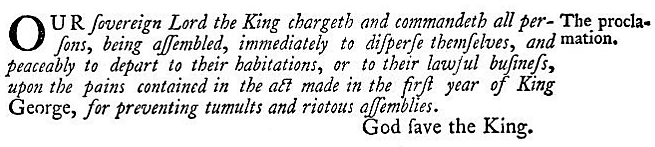
Our sovereign Lord the King chargeth and commandeth all persons, being assembled, immediately to disperse themselves, and peaceably to depart to their habitations, or to their lawful business, upon the pains contained in the act made in the first year of King George, for preventing tumults and riotous assemblies. […]
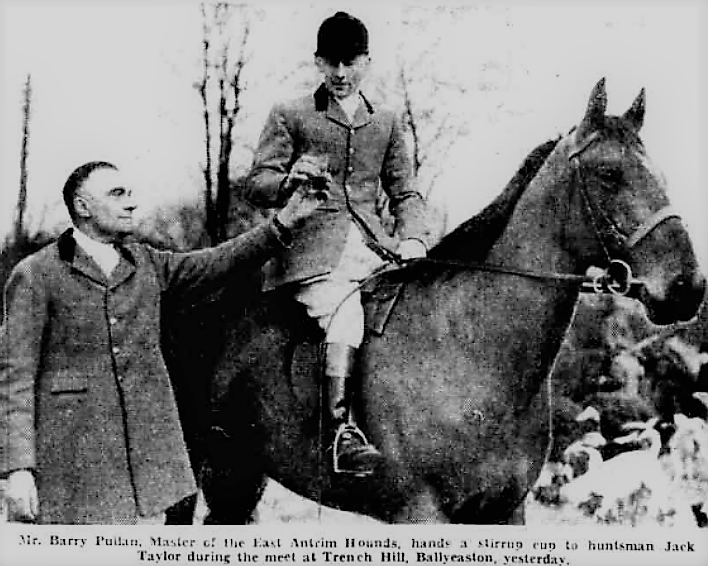
Huntsmen still use stirrup cup to designate an alcoholic drink offered to riders either as they are about to depart or when they return. Mr. Barry Puilan, Master of the East Antrim Hounds, hands a stirrup cup to huntsman Jack Taylor during the meet at Trench Hill, Ballyeaston, yesterday. from The Northern Whig and Belfast […]
Sir John Herschel The announcement last Friday of the death, at the age of 81, of the Rev. Sir John Herschel, Bart., which occurred at Observatory House, Slough, revives a host of memories of 18th century Bath. Sir John Herschel was the great-grandson of Sir William Herschel, the famous astronomer, who discovered from his scientific […]




 word histories