The phrase ‘boys in the backroom’, or ‘backroom boys’, appeared in the 1920s as a U.S. political term denoting persons exercising a surreptitious influence. The Oxford English Dictionary is therefore mistaken in saying that it originally denoted, in 1941, persons engaged in research.
‘Backward in coming forward’ means ‘reluctant, shy to do something’. The earliest instances that I have found are about funds set up in order to provide aid to soldiers wounded during the Napoleonic Wars.
Bing Crosby popularised ‘pennies from heaven’ in the 1936 film and song of the same name, but the phrase already existed; and Abraham Burstein, rabbi and author, had used ‘pennies falling from heaven’ in The Ghetto Messenger in 1928.
This proverb is first recorded in the mid-18th century as ‘take care of the pence, and the pounds will take care of themselves’ in letters that two fathers wrote to their respective children; so new was the adage that they attributed its coinage to various persons.
From Japanese ‘taikun’, ‘tycoon’ was originally the title by which the shogun of Japan was described to foreigners. The current sense originated in the Japanese Embassy to the United States in 1860, not from the use of ‘tycoon’ as a nickname of Abraham Lincoln.
Of American-English origin, ‘bag lady’, or ‘shopping-bag lady’, denotes a homeless woman, often elderly, who carries her possessions in shopping bags. The earliest instance that I have found is from The Pocono Record (Stroudsburg, Pennsylvania) of 19th June 1971.
During the Cold War, especially in the context of a possible nuclear war, ‘better red than dead’ was used to warn against uncompromising opposition to communism, while ‘better dead than red’ was used to express unconditional opposition to communism.
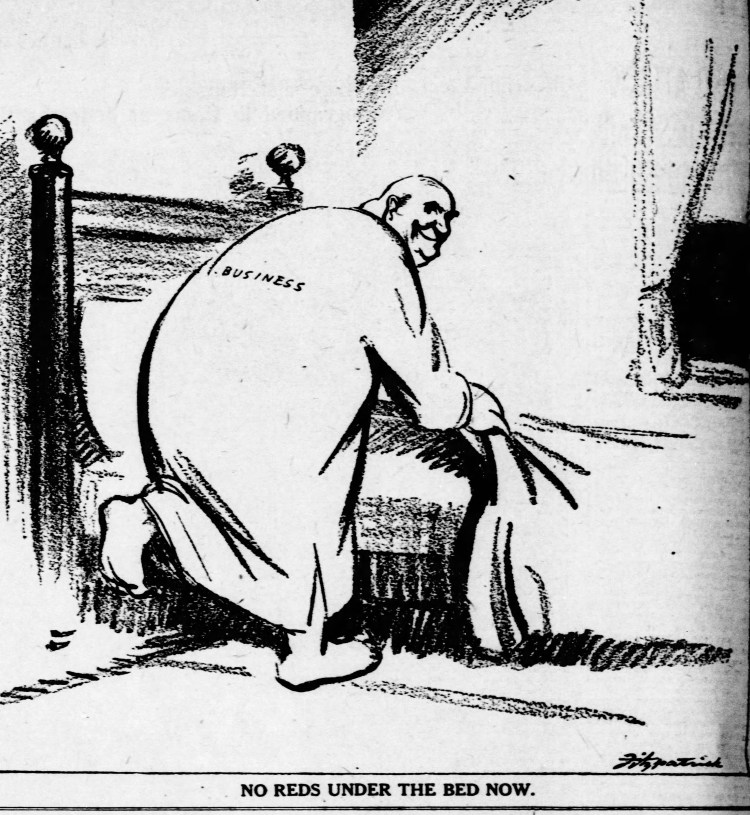
‘Reds under the bed’ and variants denoted an exaggerated or obsessive fear of the presence and harmful influence of communist sympathisers in a particular society, institution, etc. The earliest instance that I have found is from the Chicago Tribune of 28th September 1924.
‘Magazine’ (= ‘storehouse’) came to denote a book providing information on a specified subject (17th c.). This gave rise to the sense ‘periodical magazine (= ‘repository’) of the most interesting pieces of information published in the newspapers’ (18th c.).
U.S., 1903—originally used in the sense of ‘impractical scheme based on empty talk’, the element ‘blue sky’ meaning ‘unrealistic project’, and ‘hot air’ meaning ‘insubstantial claims’

 word histories