USA, 1883—exclamation of surprise at seeing something or somebody unexpected—alludes to a hunter who will lament seeing all sorts of game when he goes out into the woods and fields without his gun
USA, 1925—With, of course, a pun on ‘pee’, meaning ‘to urinate’, the jocular phrase ‘silent like (the) ‘p’ in swimming’ is used when exposing a difficulty in pronunciation.
According to superstition, if on waking on the first morning of a month one mutters to oneself ‘(white) rabbit(s)’ three times before speaking to anyone, then one will have good luck during the whole month.
UK, 18th century—addressed to one who stands between the speaker and the light of a window, a lamp, a candle or a fire, or, more generally, to one who obstructs the speaker’s view
UK—originated in British-Army slang, first to designate an unintelligent person (1943), then any ordinary soldier of the lowest ranks (1945)—finally also, in civilian usage: any ordinary person (1947)
a hypothetical ordinary working man—USA, 1970—refers to a man who buys beer in six-packs—apparently coined by a political informant on the blue-collar area of Fields Corner in Dorchester, neighbourhood of Boston, Massachusetts
UK, 1823 as ‘calf’s head is best hot’, defined by John Badcock as “the apology for one of those who made no bones of dining with his topper on” in Slang. A Dictionary of the Turf, the Ring, the Chase, the Pit, of Bon-ton, and the Varieties of Life
1951—with pun on the noun ‘camp’ (i.e.: encampment): extremely camp (i.e.: ostentatiously and extravagantly effeminate; deliberately exaggerated and theatrical in style)
a word in confidence—UK, 1927—‘shell-like’ elliptical for ‘shell-like ear’, which was originally a poetical term associating the shape of the external ear with the graceful convolutions of a small pink seashell
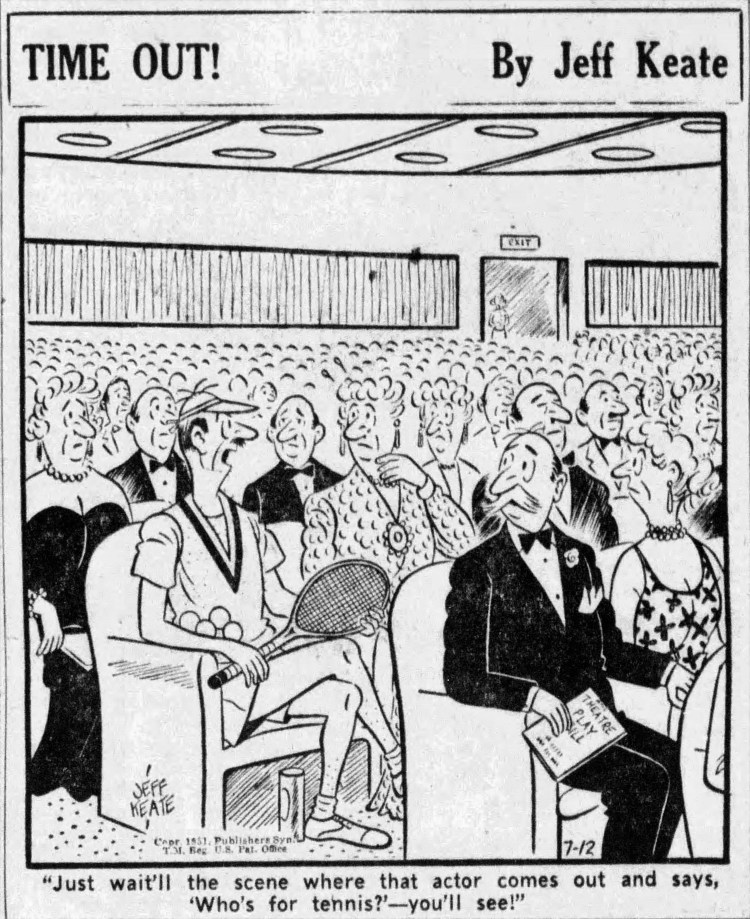
theatre—a typical entrance or exit line given to a young man in a superficial drawing-room comedy—USA 1934—but 1908 in a short story evoking the pastimes of members of the leisured class during a stay at a country house


 word histories