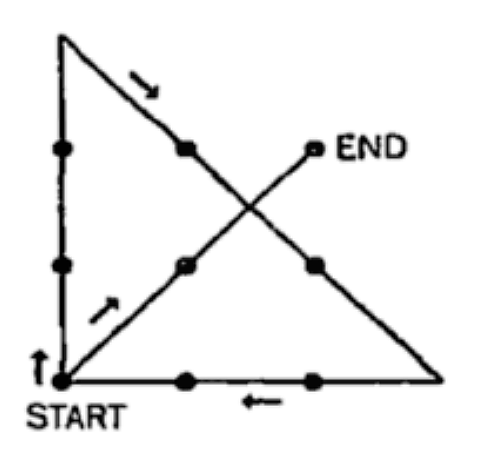
USA, 1971—to think creatively or in an unconventional manner—originated in a puzzle in which the aim is to connect nine dots arranged in the form of a square with four consecutive straight lines: the puzzle can be solved only by extending three of the lines outside the box implied by the arrangement of the dots
1947—the unauthorised dumping of waste, especially while in the process of transporting it—‘fly’ refers to ‘on the fly’, meaning ‘while in motion or progress’—‘tipping’ is the gerund of the verb ‘tip’, in the sense ‘to dump’
1687—used in negative and interrogative constructions, ‘bread and butter’ denotes a matter which one has the right to express an opinion on, involve oneself in, etc.
UK—literally, 1919: a dish consisting of meat served with two varieties of vegetable, seen as typical of traditional or unimaginative British cooking—figuratively, 1951: something simple and unsophisticated, or something indicative of simple and unsophisticated tastes
‘cross I win (and) pile you lose’ (1673)—‘heads I win (and) tails you lose’ (1728)—meaning: ‘I win whatever happens’—with reference to the practice of tossing a coin to determine a winner or to make a decision
UK, 1711—means that anyone can be right occasionally, if only by chance—often used specifically to suggest that one holding a fixed belief regardless of changing circumstances will occasionally, if rarely, be correct
UK, 1972—the offence of taking a car without the owner’s consent, especially for the purpose of joyriding, which was a social phenomenon prevalent in north-eastern England—acronym for ‘taking without owner’s consent’
USA, 1941—the person with the least amount of experience, authority and/or influence in a group or organisation—apparently coined, as ‘low man on any totem pole’, by comedian Fred Allen in a portrait of his friend, humorist H. Allen Smith
USA, 1906: a person who advocates equality for all people at a high level of prosperity (i.e., who believes in champagne for everybody)—UK, 1956: a person who espouses socialist ideals while enjoying a wealthy lifestyle


 word histories