Of American-English origin, ‘bag lady’, or ‘shopping-bag lady’, denotes a homeless woman, often elderly, who carries her possessions in shopping bags. The earliest instance that I have found is from The Pocono Record (Stroudsburg, Pennsylvania) of 19th June 1971.
During the Cold War, especially in the context of a possible nuclear war, ‘better red than dead’ was used to warn against uncompromising opposition to communism, while ‘better dead than red’ was used to express unconditional opposition to communism.
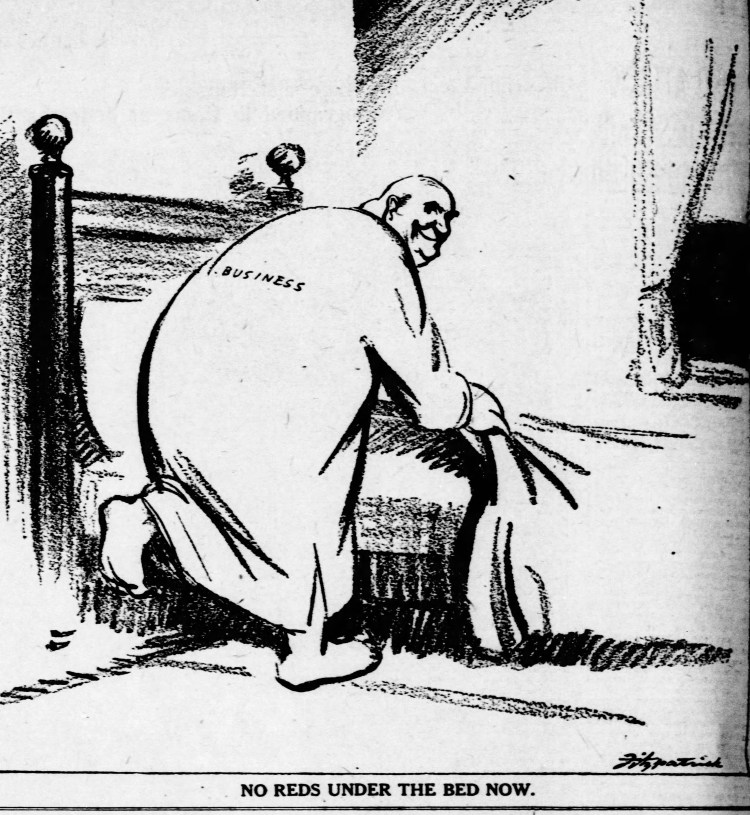
‘Reds under the bed’ and variants denoted an exaggerated or obsessive fear of the presence and harmful influence of communist sympathisers in a particular society, institution, etc. The earliest instance that I have found is from the Chicago Tribune of 28th September 1924.
U.S., 1903—originally used in the sense of ‘impractical scheme based on empty talk’, the element ‘blue sky’ meaning ‘unrealistic project’, and ‘hot air’ meaning ‘insubstantial claims’
Of American-English origin, ‘gravy train’ is first recorded in 1899 with reference to sporting achievement, not to financial gain; it originated in the use of ‘gravy’ in the figurative sense of ‘advantage’, ‘benefit’, first recorded in 1845.
Often used in phrases such as ‘to jump on the bandwagon’, meaning to join the popular or apparently winning side, ‘bandwagon’ denotes a popular party, faction or cause that attracts growing support; its primary meaning is a wagon used for carrying the band in a parade.
The colloquial phrase ‘long time no see’, which first appeared in the USA in the 1890s, is used as a greeting meaning ‘it is a long time since we last saw each other’. It originated in Chinese Pidgin English, after Chinese ‘hǎojiǔ bú jiàn’, or ‘hǎojĭu méi jiàn’.
A calque of German ‘blauer Montag’, ‘blue Monday’ originally denoted a Monday on which people chose not to work as a result of excessive indulgence over the course of the weekend. Under the influence of the adjective ‘blue’ in the sense ‘dismal’, it came to denote a Monday that is depressing or trying.
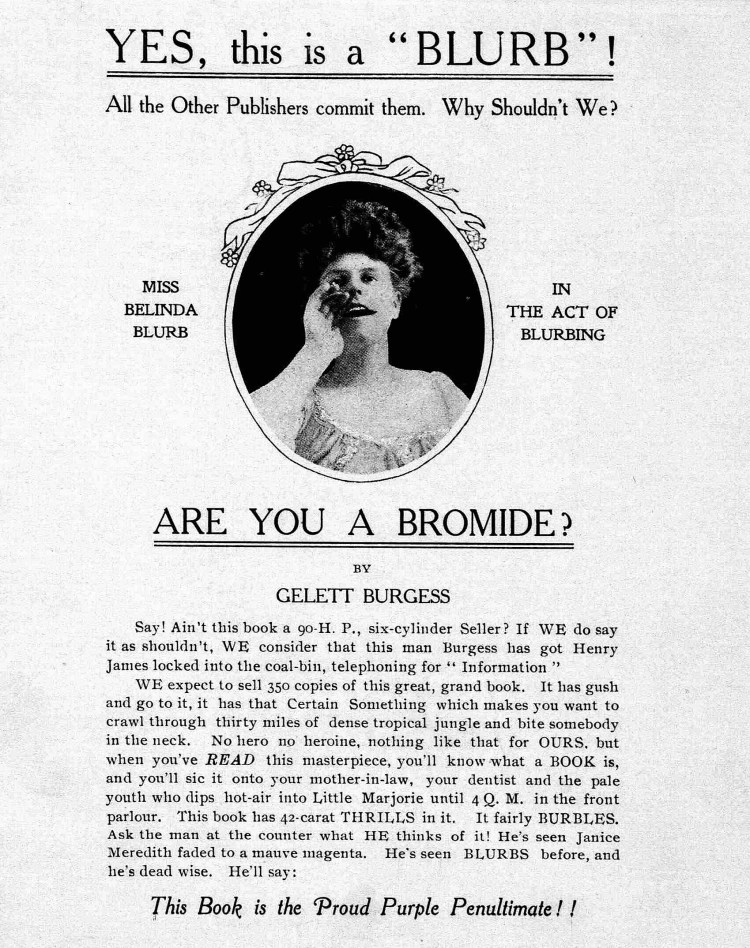
For a limited edition of his book ‘Are You a Bromide?’ sent to the guests of the 1907 annual dinner of the American Booksellers’ Association, Gelett Burgess devised a jacket showing a young lady whom he facetiously dubbed Miss Belinda Blurb.
The phrase ‘to turn up one’s toes’, meaning ‘to die’, might have originated in the Irish-English phrase ‘to turn up one’s toes to the roots of the daisies’, first found in the passive form ‘with one’s toes turned up to the roots of the daisies’, meaning ‘lying dead’.

 word histories