to live in conditions of extreme want—Australia, 1832; Ireland and Britain, 1834; USA, 1846—in early use, the phrase frequently occurs in relation to Ireland and to the armed forces
the phrases built on the pattern ‘to out-X X’, in which ‘X’ is a person’s name, mean to be superior to X in his or her characteristics—the prefix ‘out-’ has been used to form verbs conveying the sense of surpassing, exceeding or beating in the action described by the simple verb
informal and often humorous: denotes the explicit or most intimate details of something—originally (USA, 1859) referred to accounts or representations of acts of violence and bloodshed
UK, 1995—a derogatory designation of New Labour, i.e., a right-wing/social democratic trend in Labour thinking and policy, advocated by Tony Blair—‘Tory’: the British Conservative Party; ‘lite’ (phonetic respelling of the adjective ‘light’): a moderated version of something
UK, 1819—has been used in various jocular phrases referring to alcohol consumption—punningly alludes to ‘lush’, which, as a noun, denotes alcoholic drink, and, as a verb, means to consume alcohol—‘the City of Lushington’: a convivial society, consisting chiefly of actors, which met at the Harp Tavern, London
1950—the exercise of ploys and tactics in order to minimise time spent waiting in a queue—composed of the noun ‘queue’ and the suffix ‘-manship’—here, ‘-manship’ does not refer to the skills worthy of a role, as in ‘horsemanship’ and ‘statesmanship’, but to the ploys used to gain the upper hand, as in ‘gamesmanship’
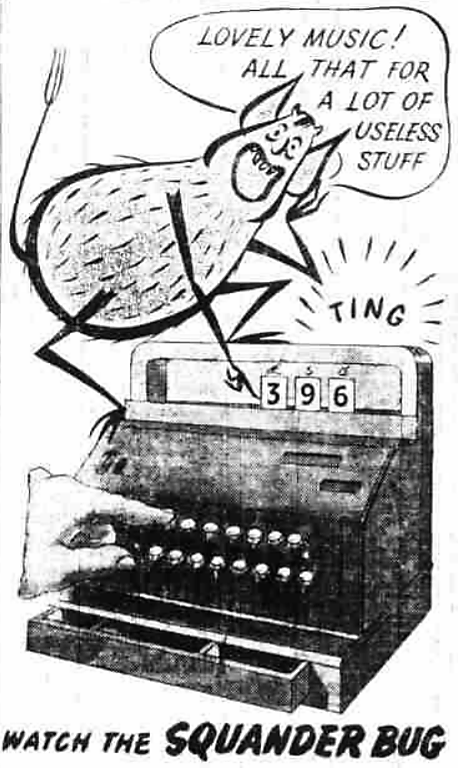
1943—a devilish insect symbolising reckless extravagance and waste—introduced by the National Savings Committee in a government publicity campaign promoting economy—hence: one who is profligate with money or resources
1907—whether one likes it or not; haphazardly—a humorous variant of ‘willy-nilly’, after the personal name ‘William’ (‘William’ being familiarly shortened to ‘Willy’)
UK—(used of a group of people) to keep passing the initiative or responsibility from one person to another, so that no action is taken—refers to a party game in which a gift wrapped in several layers of paper is passed around a circle of players to the accompaniment of music, the losers in successive rounds being those holding the parcel when the accompanying music stops
‘parting shot’ (1817); ‘Parthian shot’ (1822): a sharp, telling remark, act, gesture, etc., made in departing—‘parting shot’: literally the final shot fired at the moment of departure—‘Parthian shot’: refers to the Parthian horsemen’s habit of shooting arrows backwards while in real or pretended retreat