The verb to sack (someone) means to dismiss (someone) from employment. This verb seems to have appeared in the first half of the 19th century. For example, the Perthshire Courier (Scotland) of Thursday 29th April 1841 reported that at the Glasgow assizes, during the trial for the murder of a superintendent of Railway labourers, one […]
This word means a toilet, especially an outdoor one. The following is from A Dictionarie of the French and English Tongues (1611), by Randle Cotgrave: Retraict [modern French retrait]: masculine. An Aiax, Priuie, house of Office [= outdoor toilet]. It is a humorous respelling of a jakes, of same meaning, after Ajax, the name […]
The noun ‘gongoozler’, denoting a person who stares protractedly at anything, originally designated an idler who stares at length at activity on a canal.
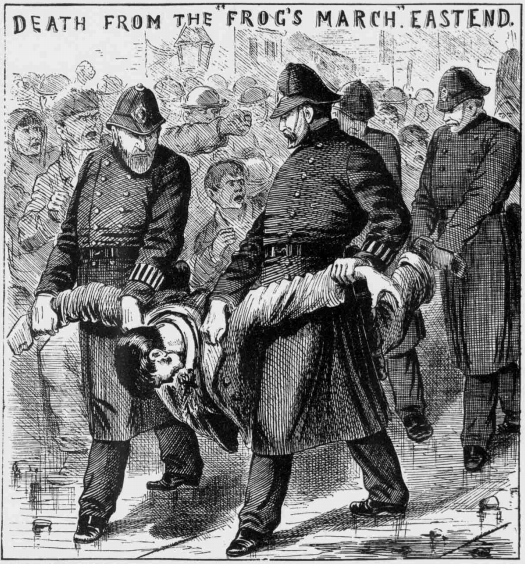
The verb to frog-march (somebody) means to force (somebody) to walk forward by holding and pinning their arms from behind. This sense is milder than the original, as the frog’s march was a police metaphor denoting a method of moving a resistant person such as a prisoner, in which he or she is lifted by […]
“Go by Shanks’ pony – Walk short distances and leave room for those who have longer journeys” – a Second World War poster by Lewitt-Him for the Ministry of War Transport – image: Imperial War Museums The phrase Shanks’(s) pony, or mare, etc, means one’s own legs as a means of conveyance. It is […]
MEANING The phrase to beggar belief (or description) means to be too extraordinary to be believed (or described). ORIGIN The literal meaning of the verb to beggar is to make a beggar of, exhaust the means of, reduce to beggary. It came to be used figuratively to mean to exhaust the resources […]
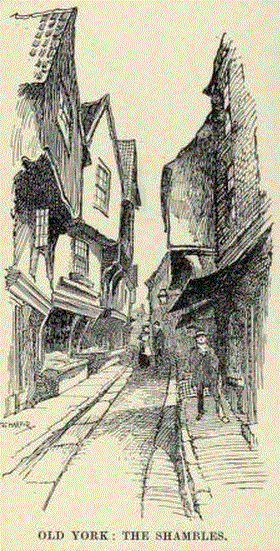
Old York: the Shambles – illustration by Charles G. Harper for his book The Great North Road: The Old Mail Road to Scotland: York to Edinburgh (1901) (The pavements are raised either side of the cobbled street to form a channel where the butchers would wash away the offal and blood.) MEANING […]
The phrase to carry coals to Newcastle means to supply something to a place where it is already plentiful; hence, figuratively, to do something wholly superfluous or unnecessary—cf. also to sell refrigerators to the Eskimos and to sell sand in the Sahara. This phrase (in which coals is an obsolete plural) refers to Newcastle upon Tyne, in […]
It was only from the mere accident of his bearing the name that he did that the phrase ‘Hobson’s choice’ was applied to Thomas Hobson (1544-1631), an English liveryman who supposedly gave his customers no choice but to take the horse closest to the stable door or none at all. MEANING The […]
MEANING The phrase donkey’s years means a very long time. ORIGIN This expression is inseparable from donkey’s ears. In fact, these two expressions were originally a single one, donkey’s years being simply a dialectal pronunciation of donkey’s ears—or the other way around. And donkey’s ears/years (also donkeys’ ears/years) was part of a […]