The phrase ‘boys in the backroom’, or ‘backroom boys’, appeared in the 1920s as a U.S. political term denoting persons exercising a surreptitious influence. The Oxford English Dictionary is therefore mistaken in saying that it originally denoted, in 1941, persons engaged in research.
‘Backward in coming forward’ means ‘reluctant, shy to do something’. The earliest instances that I have found are about funds set up in order to provide aid to soldiers wounded during the Napoleonic Wars.
From Japanese ‘taikun’, ‘tycoon’ was originally the title by which the shogun of Japan was described to foreigners. The current sense originated in the Japanese Embassy to the United States in 1860, not from the use of ‘tycoon’ as a nickname of Abraham Lincoln.
During the Cold War, especially in the context of a possible nuclear war, ‘better red than dead’ was used to warn against uncompromising opposition to communism, while ‘better dead than red’ was used to express unconditional opposition to communism.
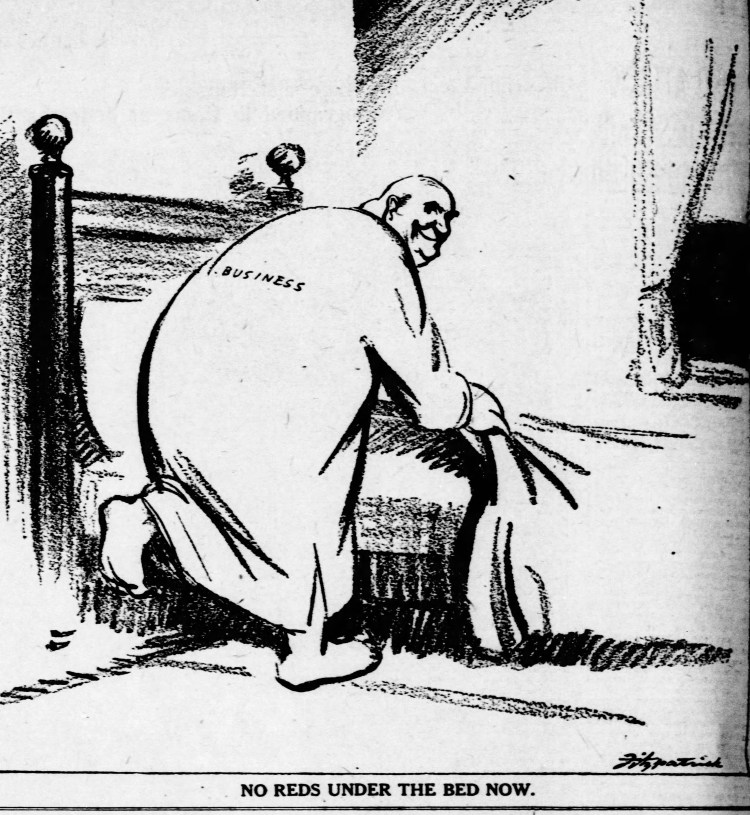
‘Reds under the bed’ and variants denoted an exaggerated or obsessive fear of the presence and harmful influence of communist sympathisers in a particular society, institution, etc. The earliest instance that I have found is from the Chicago Tribune of 28th September 1924.
Of American-English origin, ‘gravy train’ is first recorded in 1899 with reference to sporting achievement, not to financial gain; it originated in the use of ‘gravy’ in the figurative sense of ‘advantage’, ‘benefit’, first recorded in 1845.
Often used in phrases such as ‘to jump on the bandwagon’, meaning to join the popular or apparently winning side, ‘bandwagon’ denotes a popular party, faction or cause that attracts growing support; its primary meaning is a wagon used for carrying the band in a parade.
A calque of German ‘blauer Montag’, ‘blue Monday’ originally denoted a Monday on which people chose not to work as a result of excessive indulgence over the course of the weekend. Under the influence of the adjective ‘blue’ in the sense ‘dismal’, it came to denote a Monday that is depressing or trying.
The phrase ‘to turn up one’s toes’, meaning ‘to die’, might have originated in the Irish-English phrase ‘to turn up one’s toes to the roots of the daisies’, first found in the passive form ‘with one’s toes turned up to the roots of the daisies’, meaning ‘lying dead’.
U.S.—‘to see the elephant’: to see life, the world or the sights, as of a large city, to gain knowledge by experience. But in 1842, the original meaning of ‘to see the elephant’ was ‘to get sick and tired of something’.

 word histories