‘the morning after the night before’: meanings and early occurrences
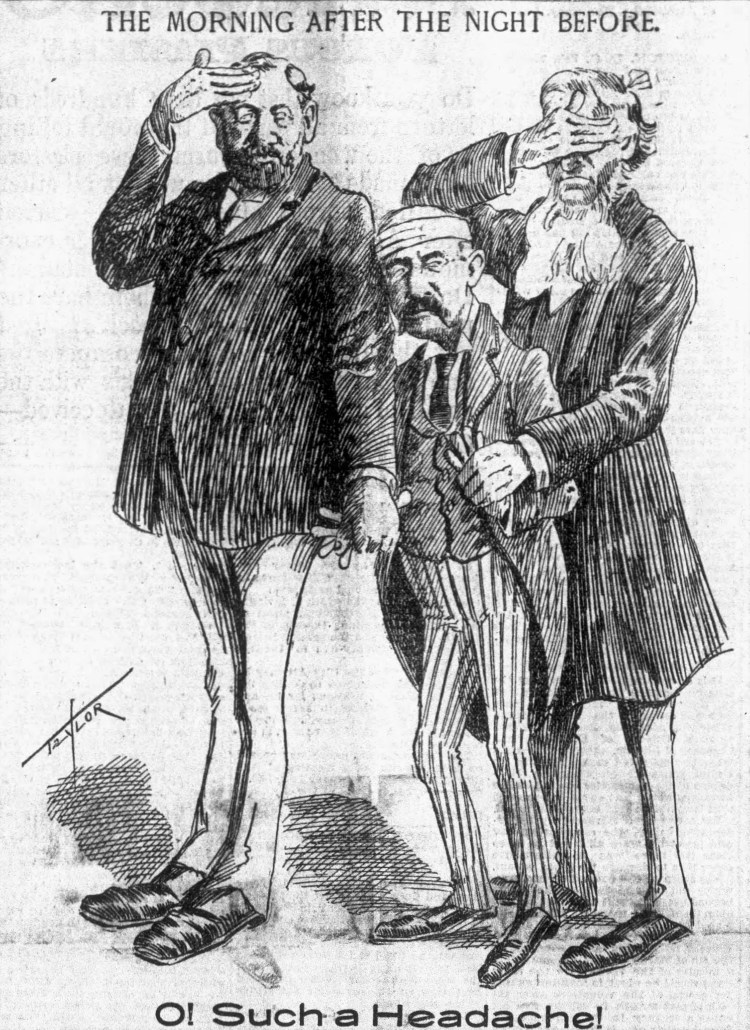
UK, 1860—the morning after an evening of drinking, when one has a hangover—in extended use: the morning after any night of excessive revelry
Read More
“ad fontes!”
UK, 1860—the morning after an evening of drinking, when one has a hangover—in extended use: the morning after any night of excessive revelry
Read MoreAustralian soldiers’ slang, 1917—literally: to fall heavily; figuratively: to suffer a failure or defeat—‘gutser’ (Scotland, 1901): originally denoted a belly flop—derived from ‘gut’ in the sense of the belly
Read More1922, slang of high-school and university students in Kansas City (Missouri) and in Kansas: a fashionable young man who enjoys socialising with women at tea parties or other social events—1924: a diplomat employed by the U.S. State Department, regarded as being excessively occupied with entertaining dignitaries and doing little meaningful work
Read Moremeaning: ‘what is appropriate in one case is also appropriate in the other case in question’—earliest occurrence in A Collection of English Proverbs (1670), by John Ray
Read MoreThe noun ‘hardy annual’ denotes a plant that can withstand freezing temperatures and which completes its life cycle within a year. In British English, this noun is used figuratively of a thing or a person that reappears continually or at regular intervals.
Read Moreearly 18th century—‘to anticipate unduly’, in particular, ‘to spend one’s revenue before it comes in’
Read MoreUSA, 2003—Following France’s opposition to the proposed U.S.-led invasion of Iraq, the expression ‘freedom fries’ was substituted for ‘French fries’. This, and other expressions in which ‘freedom’ was substituted for ‘French’, may have been coined almost simultaneously by various persons, independently from each other.
Read Morederisive, derogatory nickname for the U.S. State of Connecticut—a blend of the adjective ‘corrupt’ and of the name ‘Connecticut’—first appeared in 2003 in reference to a series of corruption scandals involving public officials
Read MoreYupik—meaning: “his mind knows what to do but he does not do it”—applied to someone who consistently violates the norms of society in multiple ways—used in January 2022 by Dominic Cummings to describe Boris Johnson
Read MoreIndia, 1958—euphemistic appellation for verbal or physical sexual harassment of a woman by a man in a public place—refers to Eve, the first woman in the biblical account of the creation of the world, who is seen as a temptress
Read More word histories