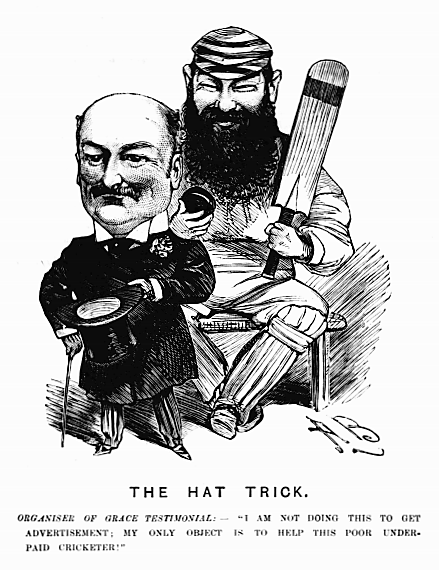
THE HAT TRICK. ORGANISER OF GRACE TESTIMONIAL: — “I AM NOT DOING THIS TO GET ADVERTISEMENT; MY ONLY OBJECT IS TO HELP THIS POOR UNDERPAID CRICKETER!” caricature from The Entr’acte & Limelight (London) – 22nd June 1895 In 1895, a testimonial fund was set up for W. G. Grace (1848-1915), the Grand Old Man […]
The verb nail is used to mean to expose or reveal the falsehood of an allegation, assertion, etc., especially to prevent further dissemination. This use is first recorded in An Oration delivered at the Celebration in Philadelphia of the 106th Anniversary of the Birthday of Thomas Paine, by John Alberger, published in The North American […]
The phrase to miss the bus, or the boat, etc., means to be too slow to take advantage of an opportunity. In A Concise Dictionary of Phrase and Fable (1993), B. A. Phythian explained: This expression is said to originate in an Oxford story of the 1840s about John Henry Newman, fellow of Oriel College, […]
The phrase a skeleton at the feast, or at the banquet, denotes a person or event that brings gloom or sadness to an occasion of joy or celebration. This was originally an allusion to the practice of the ancient Egyptians, as recorded by the Greek biographer and philosopher Plutarch (circa 46-circa 120) in The Dinner of the Seven Wise […]
A drawing of Peeping Tom, in the exact state in which he is carved, but divested of all paint and superfluous ornaments. W. Reader in The Gentleman’s Magazine: and Historical Chronicle (London) of July 1826 The Coventry Peeping Tom statue, which dates from around 1500, survives today. Though it is now stripped down to […]
MEANING outside the limits of social convention ORIGIN The primary meanings of the noun pale are a wooden stake or post used with others to form a fence and a wooden fence made of stakes driven into the ground. This word appeared in the late 14th century and is from Anglo-Norman and Middle French pal, meaning a stake, a palisade, a […]
Nowadays, a curfew is a regulation requiring people to remain indoors between specified hours, typically at night – for example: a dusk-to-dawn curfew. The word is from Old French and Anglo-Norman forms such as cuevre-feu and covrefeu, hence the Modern French word couvre-feu (plural couvre-feux), composed of: – couvre, imperative of the verb couvrir, to cover, – feu, meaning fire. The corresponding medieval Latin names were ignitegium […]
MEANING The following definition of budget is from the New English Dictionary (i.e. Oxford English Dictionary – 1888 edition): A statement of the probable revenue and expenditure for the ensuing year, with financial proposals founded thereon, annually submitted by the Chancellor of the Exchequer, on behalf of the Ministry, for the approval of the House […]
A milliner is a person (generally a woman) who makes or sells women’s hats. But a Milliner was originally a native or inhabitant of Milan, a city in northern Italy. The word is first recorded in this sense in an Act of Parliament in 1449: That every Venician, Italian, Januey, Florentyn, Milener, Lucan, Cateloner, Albertyns, […]
MEANING the fourth estate: the press; the profession of journalism ORIGIN The first known user of the expression, designating the ordinary people, was the English author and magistrate Henry Fielding (1707-54) writing, under the pseudonym of Sir Alexander Drawcansir, Knt. Censor of Great Britain, in The Covent-Garden Journal of Saturday 13th June […]