The phrase wouldn’t say boo to a goose is used to emphasise that someone is very timid. Here, boo is not an expression of disapproval but a later form of bo, an exclamation intended to frighten. In Notes and Queries of 10th September 1870, the English philologist Walter William Skeat (1835-1912) wrote: “Cry Bo to […]
The adjective fed up means annoyed, unhappy or bored, especially with a situation that has existed for a long time. The original, literal meaning is simply sated with food, since to feed up an animal or a person is to supply them with rich and abundant food. For example, the author of Whether Love be a natural or fictitious Passion, published in Pope’s Bath Chronicle of 3rd May 1764, wrote: The […]
MEANING a member of a family or group who is regarded as a disgrace to it ORIGIN This was perhaps originally an allusion to the book of Genesis, 30. Jacob has already worked fourteen years for both of Laban’s daughters, and after Joseph’s birth he desires to take leave of Laban. They reach […]
MEANING The phrase to be barking up the wrong tree means to be pursuing a mistaken or misguided line of thought or course of action—cf. also origin of ‘gone coon’. ORIGIN In Americanisms, Old and New. A Dictionary of Words, Phrases and Colloquialisms peculiar to the United States, British America, the West Indies, […]
The phrase ‘pour encourager les autres’ (‘in order to encourage the others’) was coined by Voltaire with reference to the execution of Admiral John Byng in 1757.
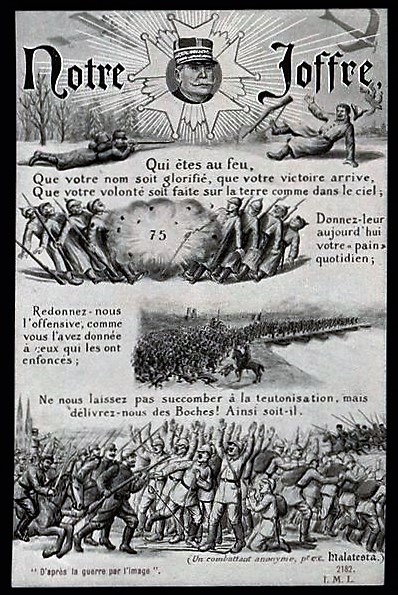
Notre Joffre (parody of the Lord’s Prayer) first published in 1914 in Le Radical de Marseille (75 refers to the French 75-mm field gun.) From 1914 to 1916, Joseph Joffre (1852-1931) was the commander in chief of the French armies on the Western Front. The following parody of the Lord’s Prayer is to be replaced […]
MEANINGS – attractive articles of little value or use – practices or beliefs that are superficially or visually appealing but have little real value or worth ORIGIN The noun trumpery, first recorded in the mid-15th century, is from the French noun tromperie, which means deception, trickery. This was one of the original meanings in […]
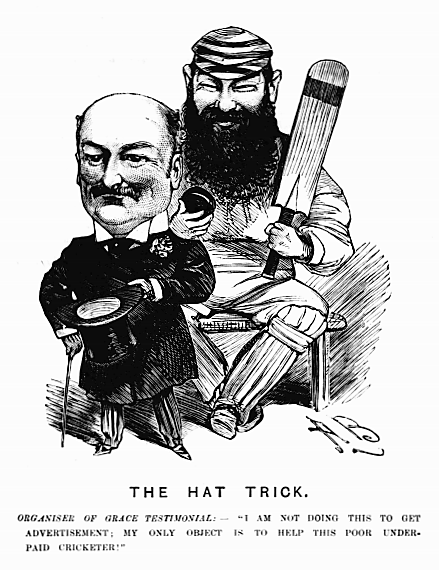
THE HAT TRICK. ORGANISER OF GRACE TESTIMONIAL: — “I AM NOT DOING THIS TO GET ADVERTISEMENT; MY ONLY OBJECT IS TO HELP THIS POOR UNDERPAID CRICKETER!” caricature from The Entr’acte & Limelight (London) – 22nd June 1895 In 1895, a testimonial fund was set up for W. G. Grace (1848-1915), the Grand Old Man […]
The verb nail is used to mean to expose or reveal the falsehood of an allegation, assertion, etc., especially to prevent further dissemination. This use is first recorded in An Oration delivered at the Celebration in Philadelphia of the 106th Anniversary of the Birthday of Thomas Paine, by John Alberger, published in The North American […]
The phrase to miss the bus, or the boat, etc., means to be too slow to take advantage of an opportunity. In A Concise Dictionary of Phrase and Fable (1993), B. A. Phythian explained: This expression is said to originate in an Oxford story of the 1840s about John Henry Newman, fellow of Oriel College, […]

 word histories