‘jukebox’: meaning and origin
a coin-operated phonograph (typically in a gaudy, illuminated cabinet) having a variety of records that can be selected by push button—USA, 1939—earlier appellation: jook organ (Florida, 1937)
Read More
“ad fontes!”
a coin-operated phonograph (typically in a gaudy, illuminated cabinet) having a variety of records that can be selected by push button—USA, 1939—earlier appellation: jook organ (Florida, 1937)
Read Moreto walk with arms extended, elbows and wrists bent at right angles, one arm up, one down—1962 in To Kill a Mockingbird—refers to the representation of the human body by the ancient Egyptians
Read More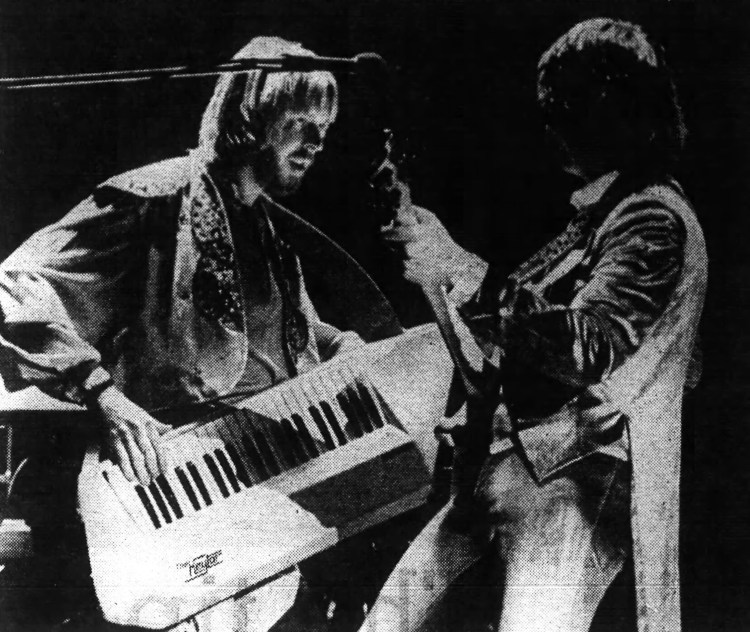
a synthesizer designed to be held in the manner of a guitar, with one hand playing a keyboard while the other operates controls on an extended handle—USA, 1979—from ‘key-’ in ‘keyboard’ and ‘-tar’ in ‘guitar’
Read Moreto have sexual intercourse—UK, Ireland and Australia, second half of the 20th century—here, the noun ‘sausage’ denotes the penis
Read Moreto do everything possible to achieve a result or effect—UK, 1865 (as ‘to pull out a few more stops’)—alludes to pulling out all the stops of an organ in order to produce a full and thrilling sound
Read Morean assumed name under which a person records a disc—UK, 1931—coined on the pattern of phrases such as ‘nom de théâtre’ and ‘nom de plume’
Read More
from the image of a speeding explosive projectile—primary meaning (of a motorcar, an aircraft, a motorcycle, an animal, a person): to move very fast—later (also ‘to go down like a bomb’ and ‘to go down a bomb’): to be very successful or popular
Read Morea lively but ineffectual young upper-class man—UK, 1959—apparently coined in the 1950s by the British jazz manager James Godbolt after ‘Hoorah Henry’, coined in 1936 by the U.S. author Alfred Damon Runyon
Read MoreAustralia—also ‘to bang like a shithouse door’—used of an exceptional sexual partner—plays on two meanings of the verb ‘bang’: ‘to make a loud noise’ and ‘to have sexual intercourse’
Read More
UK, 1989—refers to Manchester, in north-western England, as a centre of popular music and club subculture in Britain in the late 1980s and early 1990s—blend of ‘mad’ and ‘Manchester’
Read More word histories