UK, 1935—a humorous self-contradictory phrase which includes the clichéd phrase ‘to avoid like the plague’ in order to express the necessity of avoiding clichés—as a piece of advice for writers, has itself become a cliché
UK, late 1980s—the adverb ‘o’clock’ is colloquially and humorously used with adjectives to denote an unreasonably, excessively or inconveniently early or late hour—as in ‘stupid o’clock’, ‘silly o’clock’, etc.
USA, early 1930s—adjectives—‘little-girl-lost’: resembling (that of) a small girl who has lost her way—‘little-boy-lost’: resembling (that of) a small boy who has lost his way
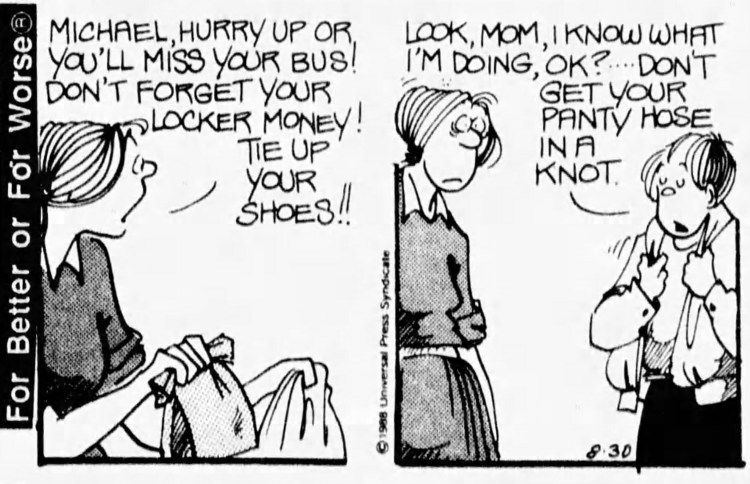
also ‘in a wad’, ‘in a knot’, etc.—to become unduly agitated or angry—the plural noun ‘panties’ refers to short underpants worn by women or girls—American English, 1975
a Latin-American television soap opera—from American-Spanish ‘tele-’ (in ‘televisión’) and ‘novela’ (‘a novel’)—1959 in American Spanish, 1961 in American English
UK, 1904—refers to the action of making someone stop chattering—from the colloquial imperative phrase ‘cut the cackle (and come to the horses)’, meaning: stop talking (and get to the heart of the matter)
U.S. slang, 1986—a march into or out of a police car, courthouse, etc., that a person in police custody is made to perform for the benefit of the news media—‘perp’: shortening of ‘perpetrator’
USA, 1937—informative material presented in an entertaining way at working-meetings (and later at other types of gatherings) organised by Shell Oil Company—a blend of ‘information’ and ‘entertainment’

 word histories