The name Hogs Norton, also Hog’s Norton and Hogsnorton, denotes a fictional town renowned for its uncultured and boorish inhabitants. It has often been used in depreciative phrases suggesting that someone is a native or inhabitant of this town. These phrases have variously associated the name: – with present-day Hook Norton, a town in Oxfordshire […]
The phrase to leave no stone unturned means to try every possible course of action in order to achieve something. (The equivalent French phrase has a cosmic dimension since it is remuer ciel et terre, literally, to move heaven and earth.) The image of turning every stone was already proverbial over 2000 years ago in […]
The sandwich (item of food consisting of two pieces of bread with a filling between them) is named after the British statesman John Montagu (1718-92), 4th Earl of Sandwich. It is generally said that the sandwich was invented because he once spent twenty-four hours at the gaming-table without other refreshment than some slices of beef […]
The phrase to steal someone’s thunder means: to use the ideas, policies, etc., devised by another person, political party, etc., for one’s own advantage or to anticipate their use by the originator. It is said to have originated in an exclamation by the English critic and ineffective playwright John Dennis (1658-1734). After the early demise […]
The term thinking cap denotes an imaginary cap humorously said to be worn in order to facilitate thinking. The earliest instance that I have found is from the Western Carolinian (Salisbury, North Carolina) of 16th October 1821: We advise the editor to put his thinking-cap on, before he hazards another such assertion. The term also […]
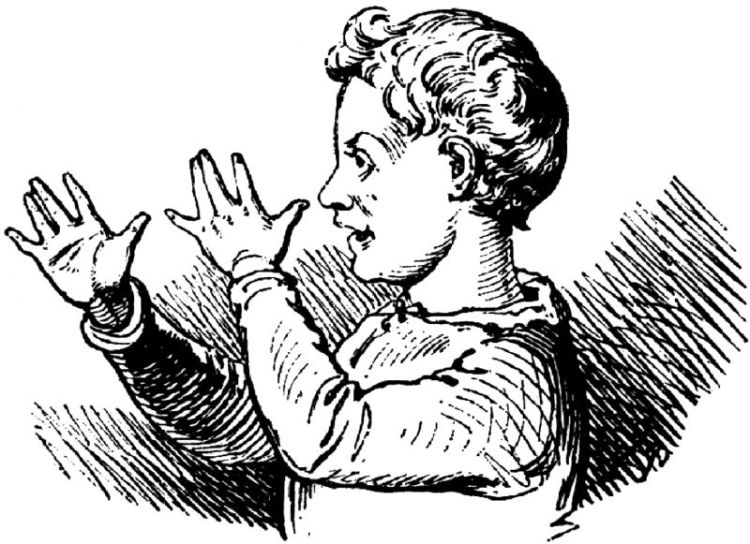
The phrase to cock (also to cut, to pull) a snook, or snooks, means: – literally: to make a gesture of derision by putting one’s thumb to one’s nose and outspreading the fingers; this gesture can be intensified by joining the tip of the little finger to the thumb of the other hand, whose fingers are […]
In the USA, cocked hat denoted a game similar to ninepins, except that only three pins were set up, in triangular position. It took its name from cocked hat in the sense of a hat with the brim permanently turned up (i.e. cocked), especially the three-cornered hat of this shape worn at the end […]
The phrase cock-and-bull story denotes an implausible story used as an explanation or excuse. The French expression sauter du coq à l’âne, literally to jump from the cock to the (male) ass, means to skip from one subject to another, the image being that incoherent talking is like switching abruptly from the topic of the cock to that of […]
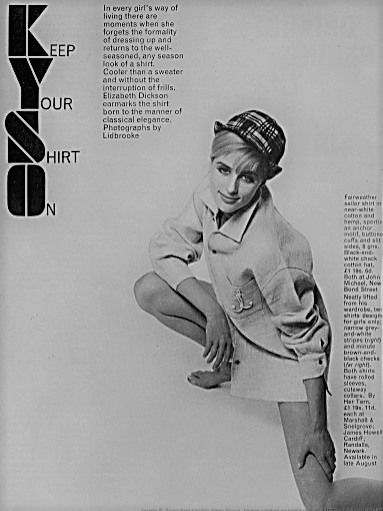
Keep your shirt on In every girl’s way of living there are moments when she forgets the formality of dressing up and returns to the well-seasoned, any season look of a shirt. Cooler than a sweater and without the interruption of frills. Elizabeth Dickson earmarks the shirt born to the manner of classical elegance. advertisement […]
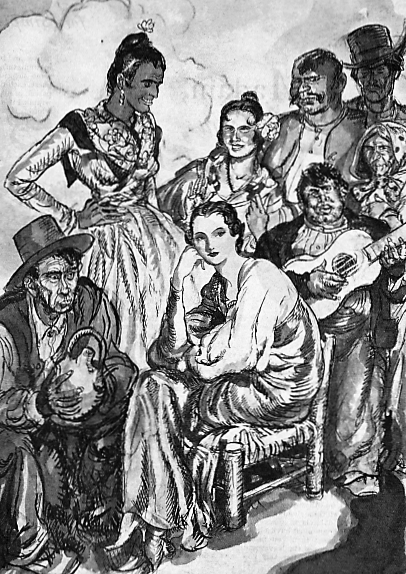
We’ll show her dressed to the nines, posing with a tribe of gypsies in the Pyrenees illustration by Steven Spurrier for The Vanishing Star. A Comedy of Love and Strategy in Hollywood, by Reita Weiman, published in Britannia and Eve (London) of December 1932 The phrase dressed to the nines means dressed […]