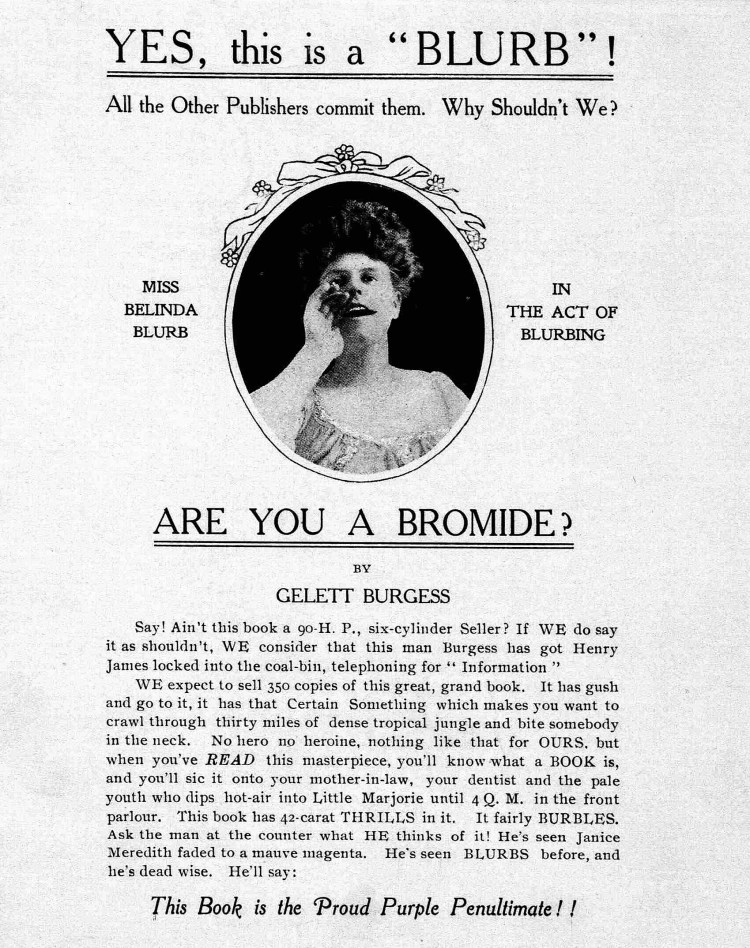
For a limited edition of his book ‘Are You a Bromide?’ sent to the guests of the 1907 annual dinner of the American Booksellers’ Association, Gelett Burgess devised a jacket showing a young lady whom he facetiously dubbed Miss Belinda Blurb.
U.S.—‘to see the elephant’: to see life, the world or the sights, as of a large city, to gain knowledge by experience. But in 1842, the original meaning of ‘to see the elephant’ was ‘to get sick and tired of something’.
The noun red tape, meaning excessive bureaucracy or adherence to official rules and formalities, refers to the use of woven red tape to tie up bundles of legal documents and official papers; the literal meaning is first recorded in 1658, the figurative meaning in 1736.
‘Atlantic’ originally referred to Mount Atlas in North Africa, on which the heavens were fabled to rest; it was hence applied to the sea near the western shore of Africa, and afterwards extended to the whole ocean lying between Europe and Africa on the east and America on the west.
Many centuries before becoming a nickname for New York City and the name of a fictional city associated with the Batman stories, Gotham was used in Britain as the name of a (probably fictional) village proverbial for the folly of its inhabitants.
The phrase to chop and change means to change one’s opinions or behaviour repeatedly and abruptly. Here, chop originally meant to barter, and change meant to make an exchange with; in other words, this was an alliterative repetitive expression, the two verbs having roughly the same meaning (cf. also, for example, the alliterative phrase to be part and […]
The phrase ‘to go to pot’ means ‘to be ruined or destroyed’, ‘to go to pieces’, ‘to deteriorate through neglect’. The allusion is to the cutting up of meat into pieces ready for the cooking-pot, as several 16th-century texts make clear.
‘Glamour’ was originally a Scottish alteration of ‘grammar’: this article explains how it came to denote an attractive or exciting quality that makes certain people or things seem appealing. Classical Greek γραμματική (= grammatikḗ) and classical Latin grammătĭca denoted the methodical study of literature, that is to say, philology in the widest modern sense, including textual […]
The 1776 French translation of Laurence Sterne’s ‘The Life and Opinions of Tristram Shandy’ gave to French ‘dada’, a child’s noun for ‘horse’, the figurative meaning of ‘favourite pastime’ or ‘pet idea’.
First recorded in The Bystander (London) on 24 January 1906, this French phrase means ‘hobby, pastime’; it refers to the passion that the French painter Jean Auguste Dominique Ingres (1780-1867) had for playing the violin.



 word histories