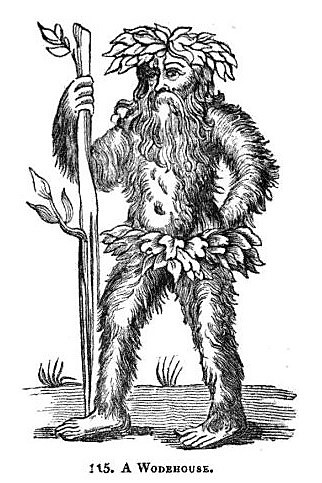
three meanings: 1/ in outdoor pageants: a man dressed in greenery, representing a wild man of the woods—2/ in inn names and signs: a forester—3/ in medieval English churches: a representation of a man’s face composed of, surrounded by, or sprouting foliage or branches
USA, 1917 (with ‘footie’): to touch somebody’s foot lightly with one’s own foot, especially under a table, as a playful expression of romantic interest—hence also, figuratively: to have underhanded dealings with somebody
UK, 1831—to startle or upset a sedate or conventionally-minded community—most probably from the following lines in The Tragedy of Coriolanus (circa 1607), by William Shakespeare: “like an eagle in a dove-cote, I | Flutter’d your Volscians in Corioli”
USA, 1930—‘to crawl, or to come, out of the woodwork’: of an unpleasant or unwelcome person or thing, to come out of hiding, to emerge from obscurity; the image is of vermin or insects crawling out of crevices or other hidden places in a building
‘double Dutch’, 19th century—from ‘Dutch’ in the sense of a language that few people can speak, and ‘double’ as a mere intensifier—‘High Dutch’, 17th century—loan translation from French ‘haut allemand’ (= ‘High German’), used in the sense of gibberish
UK, 1797—strength or confidence gained from drinking alcohol—alludes to the drinking habits ascribed to the Dutch—one of the phrases in which ‘Dutch’ is used derogatorily, largely because of the enmity between the English and the Dutch in the 17th and 18th centuries
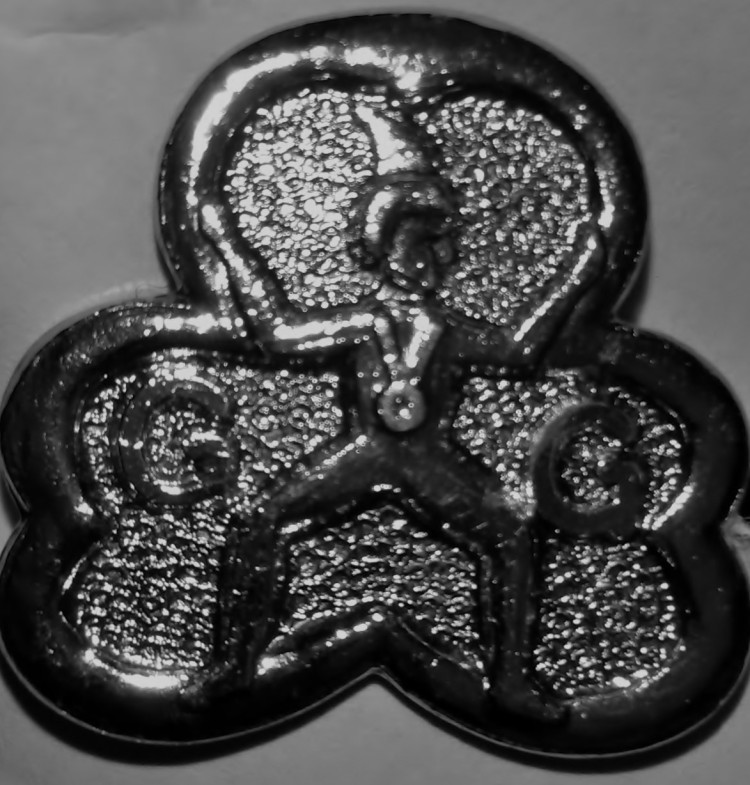
1916—from ‘brownie’, i.e. a benevolent elf that supposedly haunts houses and does housework secretly—not from the fact that the uniform of the junior Girl Scouts and Girl Guides is brown
late 16th century—from early modern Dutch ‘maelstrom’ (now ‘maalstroom’)—originally a proper name designating a powerful whirlpool in the Arctic Ocean, off the west coast of Norway, which was formerly supposed to suck in and destroy all vessels within a wide radius
from classical Latin ‘urbī’, dative of ‘urbs’ (city), and ‘orbī’, dative of ‘orbis’ (orb, circle)—in classical Latin, ‘orbis terrarum’, ‘orbis terrae’, the orb, or circle, of the earth, meant by extension the world, since the ancients regarded the earth as a circular plane or disk
1763 in French, 1798 in English—from the name of Étienne de Silhouette (1709-67), Controller-General of Finances in 1759—perhaps because he might have invented the portrait in profile obtained by tracing the outline of a head or figure by means of its shadow