‘the lion’s share’ (UK, 1790)—calque of French ‘le partage du lion’ (now ‘la part du lion’)—from ‘The Heifer, the She-Goat, and the Ewe, in partnership with the Lion’, a fable by Jean de La Fontaine (1621-95)
‘a snowball’s chance in hell’: no chance at all (USA, 1880)—elliptically, ‘a snowball’s chance’ (USA, 1895)—in the 1880s, ‘a snowball in hell’ was also used as a term of comparison to denote something that disappears rapidly
In the phrase ‘sleep tight’ (USA, 1873), the adjective ‘tight’ is used as an adverb meaning ‘soundly’, i.e. ‘deeply and without disturbance’, as in the combination ‘tight asleep’ (USA, 1847).
meaning: ‘thoroughly dejected or disappointed’—appeared (1973) in Tyne and Wear (north-eastern England)—originated apparently in football parlance, in which it soon became a cliché
UK, 1857—characterised by savage violence or merciless competition—from Alfred Tennyson’s poem ‘In Memoriam’ (1850), in which ‘red in tooth and claw’ refers to Nature’s brutality
robotically conformist or obedient—from The Stepford Wives (1972 novel by Ira Levin and 1975 film adaptation by Bryan Forbes), in which Stepford is the name of a superficially idyllic suburb where the men have replaced their wives with obedient robots
‘the milk in the coconut’: a puzzling fact or circumstance; alludes to the question of how the milk got into the coconut—of British-English origin (1832), not of American-English origin as stated by the Oxford English Dictionary
UK, 1832—‘the awkward age’: the adolescence, when one is no longer a child but not yet properly grown up, a time of life characterised by physical and emotional changes—translates in French as ‘l’âge ingrat’, ‘the thankless age’
‘a stiff upper lip’: a quality of uncomplaining stoicism—now understood as referring to what is believed to be a quintessentially British trait, the repression of emotion, but originated in fact in North America (USA, 1811)
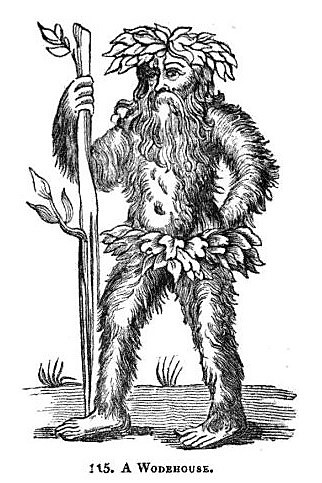
three meanings: 1/ in outdoor pageants: a man dressed in greenery, representing a wild man of the woods—2/ in inn names and signs: a forester—3/ in medieval English churches: a representation of a man’s face composed of, surrounded by, or sprouting foliage or branches

 word histories