In his comédie-ballet Le Bourgeois gentilhomme (literally The Bourgeois Gentleman – 1670), the French playwright and actor Molière (Jean-Baptiste Poquelin – 1622-73) invented the word Mamamouchi, an imaginary Turkish title that Monsieur Jourdain is gulled into thinking the son of the Grand Turk confers upon him. (Jourdain is a bourgeois whose aim is to be […]
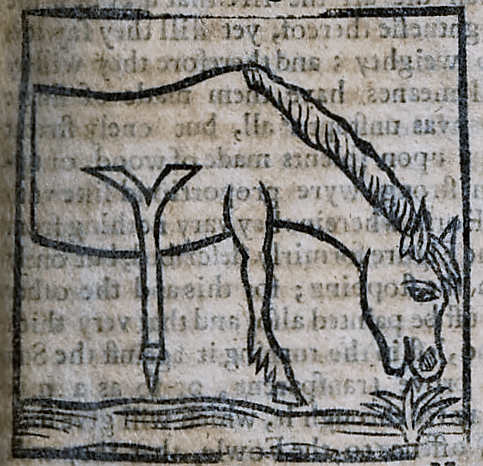
The forme and manner of the Stalking horse of Canuasse stopt. – from Hungers preuention: or, The whole arte of fowling by water and land Containing all the secrets belonging to that arte (1655 edition) The term stalking horse originally denoted a horse trained to allow a fowler to conceal himself behind it or under […]
MEANINGS – attractive articles of little value or use – practices or beliefs that are superficially or visually appealing but have little real value or worth ORIGIN The noun trumpery, first recorded in the mid-15th century, is from the French noun tromperie, which means deception, trickery. This was one of the original meanings in […]
The phrase to teach one’s grandmother to suck eggs means to presume to advise a more experienced person. Raw eggs, with or without a little seasoning, used to be a popular food and were regarded as healthy. Grandmothers obviously needed no instruction about how to drink them. The phrase is first recorded in a translation from Spanish by […]
MEANING the depths of one’s conscience or emotions ORIGIN This anatomically curious but firmly established expression is a variant of the older and more comprehensible heart of heart, meaning very centre of the heart, which was coined by the English poet and playwright William Shakespeare (1564-1616) in The Tragicall Historie of Hamlet, […]
The Latin noun halcyon, more properly alcyon, was derived from Greek ἀλκυών (= alkuon), incorrectly spelt ἁλκυών (= halkuon), meaning kingfisher. The ancients fabled that the halcyon bred about the time of the winter solstice in a nest floating on the sea, and that it charmed the wind and waves so that the sea was […]
The term field bishop denotes a person who is hanged and imagined as grotesquely giving a benediction with his jerking legs. It is first recorded in A mysterye of inyquyte contayned within the heretycall genealogye of Ponce Pantolabus (1545), by John Bale (1495-1563), Bishop of Ossory, evangelical polemicist and historian: What your ende shall be […]
In The English Struwwelpeter and the Birth of International Copyright (The Library, journal of the Bibliographical Society, 2013), Jane Brown and Gregory Jones explain that the ancient free city of Frankfurt am Main saw in 1845 the first appearance of Dr Heinrich Hoffmann¹’s Lustige Geschichten und drollige Bilder², a German children’s Christmas picture book. […]
The expression short shrift means brief and unsympathetic treatment, and to make short shrift of means to dispose of quickly and unsympathetically. A short shrift was originally a brief space of time allowed for a criminal to make his or her confession before execution. The expression is first recorded in The Tragedy of King Richard […]
Witham is the name of several villages in Lincolnshire and Essex. With a pun on wit, the expression little, or small, Witham was used proverbially for a place of which the inhabitants were remarkable for stupidity. For example, the following, from A fourth hundred of epygrams (1560) by the English playwright and epigrammatist John Heywood […]


 word histories