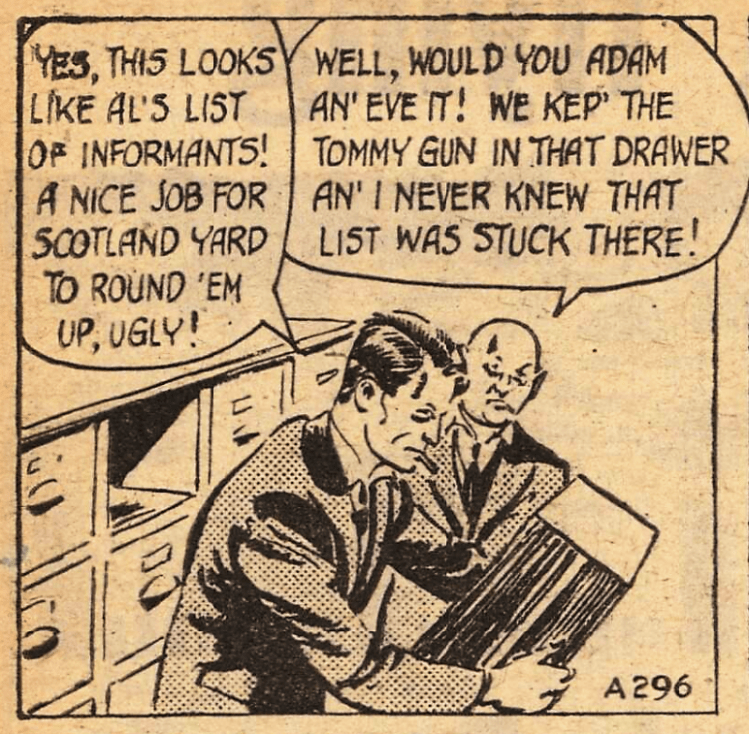
UK, 1925—the verb ‘Adam and Eve’ is rhyming slang for ‘to believe’—there is no truncation, contrary to the usual rhyming-slang formation (cf. ‘scooby’, rhyming slang for ‘clue’, which is short for ‘Scooby Doo’)
USA, 1901—wonderfully stylish, elegant or fashionable—a blend of ‘swell’ and ‘elegant’—popularised by its use in the song Well, Did You Evah!, interpreted by Bing Crosby and Frank Sinatra in the 1956 film High Society
1945—a woman from Liverpool, a city and seaport in north-western England—from the noun ‘Scouser’, denoting a person from Liverpool, and the suffix ‘-ette’, used to form nouns denoting female gender
UK, 1933—a jump made with a parachute—hence also the verbal noun ‘brolly-hopping’ and the verb ‘brolly-hop’—‘brolly’ (university slang, late 19th century): a clipped and altered form of ‘umbrella’
On the pattern of phrases such as ‘nom de guerre’, ‘nom de théâtre’ and ‘nom de plume’, ‘nom de —’ is used, often humorously, to form phrases denoting a pseudonym, an alternative name.
1947—the unauthorised dumping of waste, especially while in the process of transporting it—‘fly’ refers to ‘on the fly’, meaning ‘while in motion or progress’—‘tipping’ is the gerund of the verb ‘tip’, in the sense ‘to dump’
UK, 1972—the offence of taking a car without the owner’s consent, especially for the purpose of joyriding, which was a social phenomenon prevalent in north-eastern England—acronym for ‘taking without owner’s consent’
UK, 1849—transformation into a pumpkin; extravagant or absurdly uncritical glorification—coined after Hellenistic Greek ‘ἀποκολοκύντωσις’, the title of a travesty ascribed to Seneca, according to which the deceased Roman emperor Claudius, instead of being elevated to divine status, is changed into a pumpkin
USA, 1839—the whole group or set of people, animals or things—origin unknown—perhaps from the Dutch expression ‘de hele kit en boedel’, meaning ‘the entire house and everything in it’