coined by Thomas Jefferson in Notes on the State of Virginia, first published in Paris in 1785—literal meaning: ‘to make little’ (composed of the prefix ‘be-’ and the adjective ‘little’)—criticised in The European Magazine, and London Review of August 1787 when the book was published in London
USA, 1795—Probably a blend of ‘irrespective’ and ‘regardless’, ‘irregardless’ means the same as ‘regardless’. It is regarded as incorrect in standard English, because the negative prefix ‘ir-’ merely duplicates the suffix ‘-less’, and is therefore unnecessary.
Classical Latin ‘muscŭlus’, literally ‘a little mouse’, also denoted ‘a muscle of the body’, especially of the upper arm, from the resemblance of a flexing muscle to the movements made by a mouse; ‘muscŭlus’ was also used in the sense of ‘mussel’.
‘handbag’: to bully or coerce by subjecting to a forthright verbal assault or criticism—originally used with reference to British Prime Minister Margaret Thatcher in The Economist (7 August 1982)—from literal meaning ‘to batter or assault with a handbag’
16th century—from the Latin adjective ‘praeposterus’, composed of the adverb ‘prae’ (‘in front’, ‘before’) and the adjective ‘posterus’ (‘coming after’, ‘following’, ‘next’), so that its literal sense is ‘next (placed) first’, ‘having first what should be coming after’.
‘eggcorn’: alteration of a word or phrase through the mishearing or reinterpretation of one or more of its elements as a similar-sounding word—coined in 2003 on the website Language Log with reference to a misinterpretation of ‘acorn’ as ‘eggcorn’
from the 16th-century phrase ‘to set cock a hoop’, ‘to set (the) cock on (the) hoop’, apparently meaning ‘to put the cock (= spigot) on a barrel hoop and let the liquor flow prior to a drinking bout’—‘cock’ later equated with the fowl and ‘hoop’ with French ‘huppe’ (tufted crest)
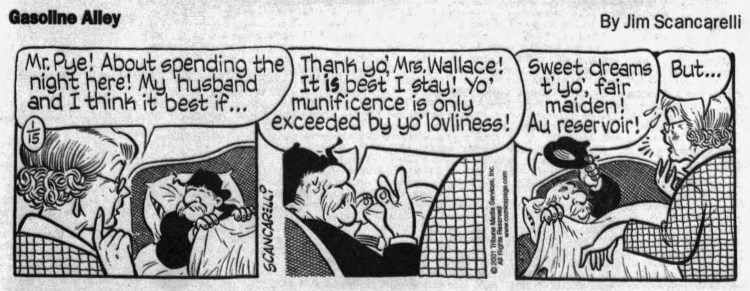
A humorous alteration of ‘au revoir’ after the noun ‘reservoir’, the exclamation ‘au reservoir’ is first recorded in Little Pedlington and the Pedlingtonians (London, 1839), by the English author John Poole (1786-1872).
from 1857 onwards in Australian newspapers, but apparently of Irish-English origin—the forename ‘Larry’ was probably chosen as a jocular reinforcement, a variant reduplication, of the adjective ‘happy’
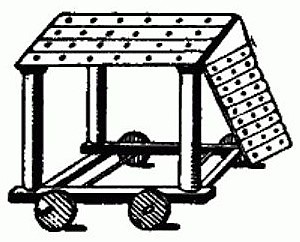
U.S., 1876—‘bulldozers’: members or supporters of the Democratic Party who used threats and acts of violence in order to prevent Afro-Americans from voting for Republican candidates


 word histories