‘chateau tap-water’ | ‘Château-la-Pompe’
tap-water likened to a grand cru—in reference to ‘château’ in names of wines of superior quality—in French ‘Château-la-Pompe’ (i.e. ‘Château-the-Pump’), ‘pompe’ denotes a device for raising water
Read More
“ad fontes!”
tap-water likened to a grand cru—in reference to ‘château’ in names of wines of superior quality—in French ‘Château-la-Pompe’ (i.e. ‘Château-the-Pump’), ‘pompe’ denotes a device for raising water
Read MoreUK, 2022— translates French ‘girouette de fer’—a derisive nickname for Liz Truss, in reference both to ‘Iron Lady’ (a nickname for Margaret Thatcher) and to Liz Truss’s changing views on a variety of subjects
Read More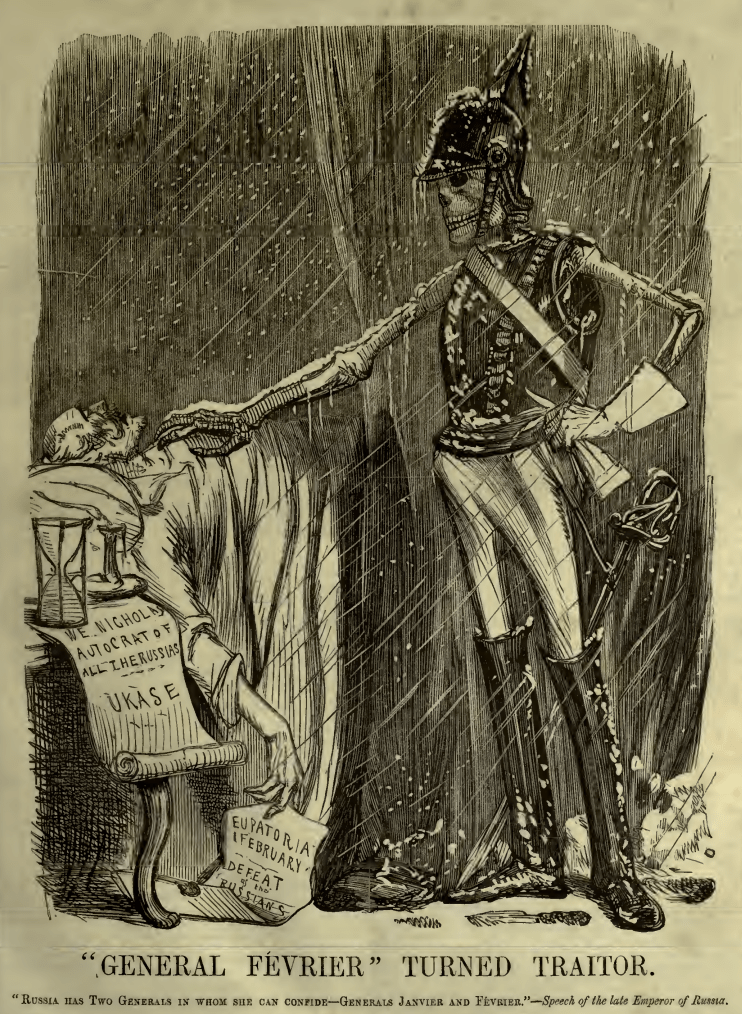
personify January and February as army commanders, especially in reference to winter as detrimental or destructive to a military campaign—apparently coined by Russian Prince Alexander Menshikov in 1855, during the Crimean War
Read Morepersonifies the winter season as an army commander, especially in reference to winter as detrimental or destructive to a military campaign—UK, 1777, in reference to the War of American Independence
Read More18th century—used humorously and ironically to denote old news, usually with the implication that the person whom the speaker is referring to is simply stating the obvious or restating a well-worn or accepted truth
Read Moreto vomit, especially from drunkenness—slang, obsolete—1609 as ‘to jerk the cat’—perhaps alludes to the fact that cats are prone to vomit—cf. also the obsolete French verb ‘renarder’, to vomit, from the noun ‘renard’, denoting a fox
Read More1942—an arena of fierce or ruthless rivalry—borrowed from French: literally ‘basket of crabs’—the image is of crabs fighting, if not devouring one another, when kept in a basket
Read More[Preliminary note: All the biblical quotations in English are from the New International Version (2011).] Le Notre-Père, the French version of the Lord’s Prayer, was revised in La Bible : Traduction officielle liturgique (Paris: Éditions Mame, 2013), the official liturgical translation of the Bible. French-speaking Catholics used to say: Et ne nous soumets pas à la […]
Read Moredesignates an Englishman—originated among the French, from the fact that they regarded the exclamation ‘God damn’ as characteristic of the English—the Middle-French synonym ‘godon’ may be etymologically unrelated
Read More1793—probably ultimately after post-classical Latin ‘mille viae ducunt homines per saecula Romam…’ (‘a thousand roads lead for ever to Rome the men…’)—the metaphor occurred in A Treatise on the Astrolabe (ca 1391), by Geoffrey Chaucer
Read More
