Eating in the Romance languages

In Latin, short words having complicated irregularities in their forms gave way to simpler words with regular patterns and longer phonetic individualities.
Read More
“ad fontes!”
In Latin, short words having complicated irregularities in their forms gave way to simpler words with regular patterns and longer phonetic individualities.
Read More
‘Wash the milk off your liver’: refers to the digestibility of milk, but misunderstood by the Oxford English Dictionary as referring to cowardice
Read More
early 18th century—from the name of the Roman orator and author Marcus Tullius Cicero, apparently in allusion to the eloquence and learning of these guides
Read More‘to season’, from Old French ‘saisonner’: ‘to do something during the proper season’, hence ‘to make appropriate to the circumstances’, ‘to flavour (a dish)’
Read Morethe troubles and activities of the world—literary or humorous, from Hamlet’s speech “to be or not be”—‘coil’: probably from Middle French ‘acueil’, encounter
Read More
In the name of the farmhouse, ‘wuthering’ is a “provincial adjective, descriptive of the atmospheric tumult to which its station is exposed in stormy weather.”
Read Morefrom the bakers’ former practice of adding a loaf to a dozen, either as a safeguard against accusations of giving light weight or as the retailer’s profit
Read More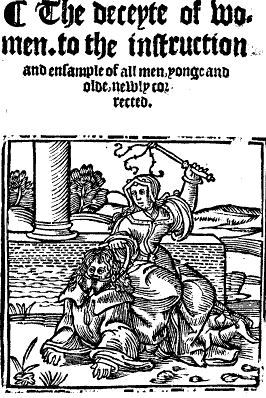
history (and Latin and French equivalents) of ‘to cut off one’s nose to spite one’s face’ (to carry out a vengeful action that hurts oneself more than another)
Read Morerefers to the possibility of finding a pearl in an oyster—coined by Shakespeare in The Merry Wives of Windsor, perhaps in allusion to a proverb
Read More1611—from French ‘omelette’, ultimately an alteration of ‘lemelle’, ‘knife blade’ (from Latin ‘lamella’), with reference to the flattened shape of the dish
Read More word histories