
[A humble request: If you can, please donate to help me carry on tracing word histories. Thank you.]
The British-English expression Skinny Lizzie, also Skinny Liz, designates a scrawny girl or woman.
This expression occurs, for example, in The Turkey and the Baby: A Christmas Story, by the British author Ralph Rochester, published in Country Life (London, England) of Thursday 5th December 2002 [page 102, column 3]:
The children’s nanny,
old Marigold, was somewhat skinny
and, sad to tell, young Bert and Jack
would call her names behind her back
like Skinny Liz or Lanky Betty
or Needle-knees or Beanpole-Betty.
The expression Skinny Lizzie, also Skinny Liz, may have originated in the title of a successful song—and in the name of an equally popular character—created in 1911 by the British comedienne Lily Long (1885-1939).
The earliest mention that I have found of the song entitled Skinny Lizzie is from a review of a programme presented at the Bedford Music Hall, in London, published in The Era (London, England) of Saturday 2nd September 1911 [page 21, column 3]:
A diverting turn is that of Lily Long, whose name well suits the owner, for the lady is very tall. Miss Long is, we believe, a comedienne who is new to London. However, she will soon become known, for she has a fine sense of humour, and her song, “Skinny Lizzie,” made a big hit, keeping her audience vastly amused.
The following photograph of Lily Long as Skinny Lizzie is from The Ladies’ Field (London, England) of Saturday 6th January 1917 [page 288, column 2]:

The character of Skinny Lizzie created by Lily Long acquired a mythical status, according to the following from the column Look Here, published in Sport (Dublin, County Dublin, Ireland) of Saturday 26th January 1918 [page 1, column 3]:
Music Hall and Panto. comedians have in the past made their audiences familiar with such mythical personages as Nosey Parker, Skinny Lizzie, and Dirty Dick; but can anyone tell me the origin of “Mayor Goodman,” whose name is often mentioned in one of our pantomimes?
The expression Skinny Lizzie, also Skinny Liz, came to be used in a variety of meanings. The following, for example, is from Mems from the Mount, published in The Aberdare Leader (Aberdare, Glamorgan, Wales) of Saturday 6th January 1917 [page 2, column 4]:
A Mount toff won a turkey in a certain competition. In his absence the bird earned the name of Skinny Lizzie. I think it’s an awfully thin joke, and besides, the sex is wrong.
In particular, during the First World War (1914-1918), the expression Skinny Lizzie, also Skinny Liz, designated a type of anti-aircraft gun used by the Union of South Africa in the campaign to take the German colony of South-West Africa.
The earliest mention that I have found of this use is from a letter written by “a Ross-shire man, serving with General Botha’s forces in South-West Africa”, published in The Ross-shire Journal and General Advertiser for the Northern Counties (Dingwall, Ross and Cromarty, Scotland) of Friday 4th June 1915 [page 7, column 1]:
We had been reinforced by an anti-aerial craft gun (bearing the by no means aristocratic name of “Skinny Liz”).
The following photograph is from The Conquest of German South-West Africa and the Surrender of the German Forces to General Botha, published in The Sphere (London, England) of Saturday 17th July 1915 [page 58, column 1]:
The “Skinny Liz”—Anti-Aircraft Gun in South-West Africa.

And the following is from The Song of Skinny Lizzie, by John Hawkes, Grey Nun’s Hospital, Regina, Canada, published in the Kent Messenger & Gravesend Telegraph and Dartford News (Maidstone, Kent, England) of Saturday 24th July 1915 [page 10, column 1]:
The bold Rhodesians had an anti-aircraft gun;
And the regiment loved her dearly, and made her quite a pet,
And they called her “Skinny Lizzie,” and she’s “Skinny Lizzie” yet;
And when the aero made a swoop, then Skinny Liz would yell,
And off the aero went to heaven, for fear she’d go to hell.
Give a cheer to Skinny Lizzie, Rhodesia’s iron belle.
I have also found the following occurrence of the expression Skinny Lizzie, of obscure meaning, in Risca. Comments from Outside, published in the Blaenavon & Abersychan Weekly Argus (Blaenavon, Monmouthshire, Wales) of Saturday 12th October 1918 [page 6, column 5]:
Risca miners derive some satisfaction from the fact that a few officials have been trained in mine rescue work, but they do not appear to be sufficient in number or well organised enough to work on their own. When the recent gob fire took place at Risca Old Black Vein Colliery the Crumlin Brigade had to be called in. It is considered by many of the men that no “Skinny Lizzie” methods should obtain in this important matter. Miners should be trained as well as officials, and given systematic practice in “galleries” above ground and in the mines; educated in the knowledge of the composition, density, and other characteristics of noxious mine gases; and trained to act in emergencies where only specially trained men with apparatus can do anything.
These are, in chronological order, the earliest occurrences that I have found of the expression Skinny Lizzie, also Skinny Liz, used in the sense of a scrawny girl or woman:
1-: From the following poem—and from the caption to the picture illustrating it—published in the Dundee People’s Journal (Dundee, Angus, Scotland) of Saturday 19th February 1916 [page 3, column 4]:
SKINNY LIZZIE
JOHN’S ST VALENTINE’S ORDEALS.
SKINNY LIZZIE
“But Skinny Lizzie at the Byers,
She was the warst o’ a’.
I left the hauf o’ my coat wi’ her
Afore I got awa’!
I never, no’, in a’ my life
Have seen the like afore,
And”—here he stopped—“I hear a step!”
He yelled, “Quick, lock the door!”Puir man, he’s hardly ventured oot
The door sin’ syne! He says
He’s feared for Skinny Lizzie and
Her too affectionate ways.
“I’m no’ sae feared at Muckle Meg,
The widow, or Big Belle,
But Skinny Lizzie! Marry her?
I’d rather droon mysel’!”Granny.

2-: From the column By the Way, published in the Yorkshire Telegraph & Star (Sheffield, Yorkshire, England) of Friday 26th November 1920 [page 4, column 3]:
No one understands why women dress themselves as they do. The low cut bodice enables the girl with a pretty neck to make the fact public by day as well as night, but the girl whose neck is not pretty is not less eager to display it. Possibly she does not know the truth. And so at the other end Fat Emma and Skinny Lizzie vie in the shortness of their frocks.
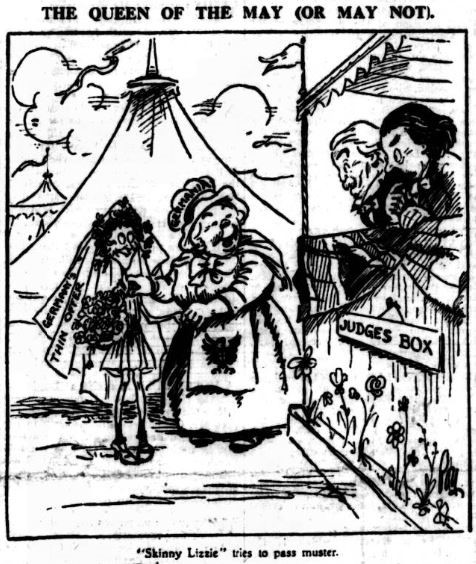
3-: From the caption to the following cartoon, published in the Weekly Dispatch (London, England) of Sunday 1st May 1921 [page 1, column 3]:
—This cartoon depicts “Germany’s thin offer” as a scrawny girl holding a bunch of flowers, being entered into a beauty contest by her mother, “Germania”:
THE QUEEN OF THE MAY (OR MAY NOT).
“Skinny Lizzie” tries to pass muster.
4-: From the following advertisement, published in the Western Mail (Cardiff, Glamorgan, Wales) of Thursday 26th January 1922 [page 2, column 2]:
SKINNY Liz.—You would soon improve your figure if you took IRVONA, the wonderful flesh builder. Ask your Cardiff Chemist about it, but don’t mistake the name!
5-: From the column Spectator in Warwickshire, published in the Coventry Standard and General Advertiser for Warwickshire & Midlands (Coventry, Warwickshire, England) of Friday 3rd February 1922 [page 4, column 2]:
—The reference is to Lady Godiva, an 11th-century noblewoman who, according to legend, rode naked through Coventry in order to obtain remission for the townspeople from the heavy taxes imposed by her husband, Leofric, Earl of Mercia—cf. the authentic history if the phrase ‘peeping Tom’:
I was considerably amused on Monday by the receipt of a communication containing the following:—
“Dear ‘Spectator,’—It is very often left to the strangers within our gates to correct us in history. For centuries the people of England have read, and have been told, of the escapade of Peeping Tom which cost that daring individual his sight. […]
“[…] In all the versions of the legend it has never yet been recorded what was Tom’s opinion of the form he risked so much to see. We have been left to conjecture whether her ladyship was fair, fat and forty; whether she was exquisitely built, with shapely limbs and an attractive contour; or whether she was of the ‘skinny Lizzie’ type.”
Morris Marples recorded the expression Skinny Liz as follows in Public School Slang (London: Constable & Company Limited, 1940) [page 190]:
WOMAN. Self-consciousness gives a derisive and rather off-hand tone to many of the school slang expressions applied to members of the opposite sex. One of the commonest terms is hag, which is applied to women of all ages: some schools, however, reserve it for the maids […], while others […] apply it, quite respectfully, to the matrons. Ma is sometimes used of middle-aged women […], or more specifically of matrons. St Bees […] used wimp (a corruption of women) and the Arabic bint of women in general, while skinny liz [sic] was applied, almost as a nickname, to any elderly woman. Young women or girls are most often tarts, birds or even dames, in accordance with the general fashion. But Bootham (1925) used betty, Durham (PSWB 1, before 1900) had the mysterious nezzar, and Pocklington Grammar School (1923+ 2) preferred the good old English wench.
1 PSWB refers to Public School Word-Book (1900), by J. S. Farmer.
2 The sign + after a date means that the use of the word in question begins with that date.
 word histories