
[A humble request: If you can, please donate to help me carry on tracing word histories. Thank you.]
MEANING
The Australian and New-Zealand phrase magic pudding designates an inexhaustible supply of something, especially money.
This phrase occurs, for example, in Dollar wise: Rental property’s uncertain return, by Diana Shand, published in The Press (Christchurch, Canterbury, New Zealand) of Tuesday 27th October 1981 [page 16, column 4]:
Property (particularly rental property) seems a very good investment at the moment. […]
This makes some investors not only smug, but rich. And people lucky enough to own their own homes also feel good.
After all, their money is in something which is proving to hold its own value against inflation. In fact, property appreciation has exceeded the inflation rate over the last year.
Property looks like a most excellent magic pudding.
ORIGIN
The phrase magic pudding alludes to The Magic Pudding: Being the Adventures of Bunyip Bluegum and his friends Bill Barnacle and Sam Sawnoff (Sydney: Angus & Robertson, 1918), a children’s book written and illustrated by the Australian artist and author Norman Lindsay (1879-1969), in which Albert, a ‘cut-and-come-again’ pudding, instantly renews itself as it is sliced or eaten into.
EARLY OCCURRENCES
These are, in chronological order, the earliest occurrences of the Australian and New-Zealand phrase magic pudding that I have found:
1-: From the column Things that Matter… and “that” don’t, by Mary Fanecourt, published in The Sydney Morning Herald (Sydney, New South Wales, Australia) of Thursday 17th May 1934 [Women’s Supplement: page 2, column 1]:
A girl who starts out on married life well equipped for the duties that will soon be pressing upon her will be all the better for it. A tidy home, a well-cooked meal (even though it be a frugal one), cheery words, and thoughtful ways—these, to my mind, are the main ingredients in the magic pudding.
2-: From The Advertiser (Adelaide, South Australia, Australia) of Wednesday 26th August 1936 [page 22, column 2]:
SECTION 92
Section 92 of the Commonwealth Constitution has done duty as the piece de resistance at more than one conference of Federal and State Ministers; but, like Mr. Norman Lindsay’s magic pudding, it was formerly quite unaffected by the freedom with which all concerned were wont to “cut and come again,” and gave promise of providing a perennial, if not very digestible, feast—until, in a decisive hour, it was submitted to the tender mercies of the Privy Council. In the form in which it emerged from this ultimate legal banquet, Section 92 was a very much altered comestible; and, when it is placed in the centre of the table at the all-Australian Ministerial Conference today, it will be in some little danger of being disposed of altogether. It no longer exhibits its old quality of inexhaustibility as a political issue.
3-: From the caption to the following cartoon, published in The Bulletin (Sydney, New South Wales, Australia) of Wednesday 15th September 1948 [page 7]:
—This cartoon depicts a man eating a huge pudding labelled tax revenue, while a small koala, holding a plate with very little food on it, is looking at him angrily:
THE MAGIC PUDDING.
( Acknowledgment to Norman Lindsay.)
“Marvellous pudding this; the more I eat the bigger it seems to grow.”
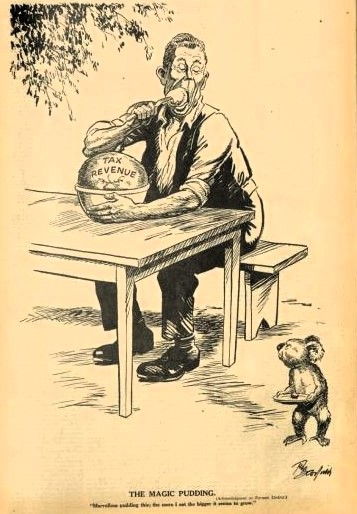
4-: From Kikuyu Lawn Wins Popularity, published in The Nambour Chronicle and North Coast Advertiser (Nambour, Queensland, Australia) of Friday 14th January 1949 [page 2, column 4]:
Kikuyu is not a lazy man’s grass. It must be cut and cut again, especially when summer storms are prevalent promoting rapid growth. Sometimes it has to be mown twice a week, but, like the “Magic Pudding” in Norman Lindsay’s book for children, it improves with cutting, and its green and even splendour repays the energetic gardener.
5-: From Youth and the Future, published in The Bulletin (Sydney, New South Wales, Australia) of Wednesday 19th August 1953 [page 5, column 1]:
What needs to be recognised is that the old saying that you can’t have your cake and eat it, too, is as true today as it ever was, though there is a tendency in Government circles to pretend that modem economics have made it obsolete. Lord Keynes used the homely illustration of the cake to exemplify the part savings play in the national economy, but the Welfare State envisages the national cake as a sort of improved Norman Lindsay Magic Pudding that is supposed not only to renew itself as fast as it is eaten, but to grow bigger and bigger all the time.
6-: From the caption to the following cartoon, published in The Bulletin (Sydney, New South Wales, Australia) of Wednesday 14th December 1960 [pages 4 & 5]:
—This cartoon depicts the Australian economy as Albert, the Magic Pudding, chased by a group of people armed with various cutting instruments (knife, meat cleaver, scythe, etc.); in the background on the left-hand side are Bill Barnacle, Bunyip Bluegum and Sam Sawnoff:
THE MAGIC PUDDING
“A good thing it’s a cut-and-come-again pudding!”

7-: From Rome Newsletter, by Desmond O’Grady, published in The Bulletin (Sydney, New South Wales, Australia) of Saturday 24th November 1962 [page 19, column 1]:
Miracles are not uncommon in Italy but Italians are surprised that their much-publicised economic miracle is producing yet another, cultural one. Everyone is so tired of soaring production graphs, export records and other boom bulletins that there have been widespread strikes for a bigger slice of this magic pudding called gross national income.
8-: From Those were the days, by Desmond O’Grady, published in The Bulletin (Sydney, New South Wales, Australia) of Saturday 7th March 1970 [page 65, column 2]:
The swan song of Italian opera has reached a new plaintiveness […].
[…]
[…] Its role in Italian society was roughly equivalent to that played by Dickens and other popular novelists in Victorian England.
But a theatre devoted to preserving the musical equivalent of 19th-century novels, or say a repertory of 19th-century plays, is really a museum. Italian opera, however, pretends that these works are contemporary.
An elaborate bureaucracy has grown up to administer this fiction, while those working in opera are organised in militant unions determined to obtain ever-larger slices of the opera magic pudding.
9-: From a review of The Bad Popes (London: Hamish Hamilton Ltd, 1970), by the British historian Eric Russell Chamberlin (1926-2006)—review by Martin Johnston, published in The Bulletin (Sydney, New South Wales, Australia) of Saturday 7th November 1970 [page 60, column 3]:
Over the 600 years the book covers we find the Throne of St. Peter being squabbled over like a well-gnawed bone (containing infinitely replenishable marrow, a la Magic Pudding) by the great Italian families (Orsini, Gaetani, Colonna, and of course the Borgia and the Medici), by monarchs and statesmen all over Europe, through interminable wars, factions, plottings, treacheries, and assassinations.
10-: From the column Candid Comment, by ‘Onlooker’, published in The Sun-Herald (Sydney, New South Wales, Australia) of Sunday 18th February 1973 [page 40, column 2]:
Sobering up
In Norman Lindsay’s story, “The Magic Pudding,” that singular comestible had the invaluable property of renewing itself after every meal. No matter with what gusto the diners regaled themselves, the pudding was restored intact.
Now, if only the public exchequer were like that: cut and come again and never run out of funds. Federal Labor Ministers, in fact, have been behaving exactly as though the Treasury was indeed a financial magic pudding, inexhaustibly replenished.
Spending appetites sharpened by long abstinence, they have trotted up with their plates and received generous helpings—a million dollars for one scheme, two million for another—and practically no questions asked.
11-: From a review of The Totalitarian Temptation (London: Martin Secker & Warburg Ltd, 1977), by the French author Jean-François Revel (1924-2006)—review by Marian Sawer, published in The Canberra Times (Canberra, Australian Capital Territory, Australia) of Saturday 18th February 1978 [page 12, column 8]:
Revel’s work is not scholarly but it is often stimulating even, or particularly, where its bias is not acceptable. It covers in a fairly disorganised way a host of issues including the “general crisis of capitalism”, the future of the nation-state, industrial democracy and the nature of anti-Americanism. In other words a view from Paris of interest to Australian social democrats concerned with more than the redistribution of our own magic pudding.
12-: From Start the season on bubbly, by Kevin Childs, published in The Age (Melbourne, Victoria, Australia) of Tuesday 27th November 1979 [Epicure Christmas special lift-out: page 1, column 2]:
One observation of an extremely pleasant afternoon is that some guests […] showed a splendid ability to change from straight orange juice to champagne once the French vintages appeared.
[…]
As more bottles were brought out, the day seemed to extend forever. A guest remarked that the fridge was like a Magic Pudding. And they all stayed on.
13-: From Do we need more reference books?, by Michele Field, published in The Sydney Morning Herald (Sydney, New South Wales, Australia) of Saturday 23rd May 1981 [page 43, column 2]:
Reference books are the magic pudding of publishing houses.
Why we seem able to generate and absorb reasonably priced reference works at such a prodigious rate is unclear.
14-: From Transfer fees go to ‘slave-masters’, by Bill Mandle, published in The Canberra Times (Canberra, Australian Capital Territory, Australia) of Sunday 28th June 1981 [page 6, column 4]:
Walter Bagehot, that keen 19th-century analyst of politics and society, once wrote of the “cake of custom, a sustaining confection elaborately compounded and lengthily baked”. It may be that in sport it is the cake of custom that nourishes the transfer fee system.
Some sports, notably cricket, have never had it. Others, more wholeheartedly professional, have had it from earliest times. The cake has become in practice a Norman Lindsay magic pudding, everlasting and infinitely renewable.
 word histories