
[A humble request: If you can, please donate to help me carry on tracing word histories. Thank you.]
The expression candid camera designates a small camera for taking informal photographs of persons, usually without their knowledge.
The first occurrence that I have found of candid camera explicitly used in this sense is from The Graphic: The National Weekly (London, England) of Saturday 11th May 1929—cf., below, quotation 6.
What candid camera precisely designates is often unclear in the earlier texts that I have found—cf., below, quotations 1 to 5—but the expression does not seem to designate a small camera designed to take informal photographs of persons.
These are, in chronological order, the earliest occurrences of candid camera that I have found:
1-: From Golf. “There is no end.”, published in The Manchester Guardian (Manchester, Lancashire, England) of Monday 2nd September 1907 [page 5, column 2]:
Those of us who are not open champions have really, without any whispers about grapes being sour, something to be thankful for. If open championship began and ended there, it might be an interesting enough function, but it only begins there and goes almost interminably further. Massy 1 will, of course, have to write a text-book on the game under the pretentiously candid camera, and he may be called upon to open an odd bazaar or two, or adjudicate a limerick competition. Such duties he will, one has no doubt, perform with unfailing grace; he may even laugh them off with some trite but thunderously applauded quotation about heads that lie uneasy.
1 The French golfer Arnaud Massy (1877-1950) had won the 1907 Open Championship held on Thursday 20th and Friday 21st June at the Royal Liverpool Golf Club in Hoylake, England.
2-: From A Radio-active Dream, published in The State (Columbia, South Carolina, USA) of Monday 13th October 1913 [page 4, column 3]:
A day or so ago the New York papers carried a vivid snap-shot of Joseph Choate 2, a visitor at the Sulzer trial 3.
We associate Choate with all that is most resourceful, vigorous and mentally alert in the practice of the legal profession.
Yet the candid camera showed him as he is, a doddering old man, with shaking hands, and bending knees, and simpering smile.
2 Joseph Hodges Choate (1832-1917) was a U.S. lawyer and diplomat.
3 The U.S. lawyer and politician William Sulzer (1863-1941) was the 39th Governor of New York from Wednesday 1st January 1913 until his impeachment on Friday 17th October 1913.
3-: From one of the contributions making up the column Mirth in the Mill, published in The Cotton Factory Times (Manchester, Lancashire, England) of Friday 3rd October 1919 [page 2, column 3]:
The Candid Camera.
Mary Emma, our bobbin carrier’s daughter, while on her holidays at Blackpool had her photograph taken with one of the new American telescope cameras—ready-in-one-minute style—and when the photographer produced the finished photo she exclaimed:
“This isn’t me, mestur. Why, mi hair’s not straight, un mi blouse is eawt 4; un besides, yo’n took mi skennin’ 5!”
“Well!” exclaimed the photographer, “’ow the devil could I take yer any other way!”
Jim, Great Lever.
4 Here, eawt is a dialectal variant of out.
5 The dialectal verb sken means to squint.
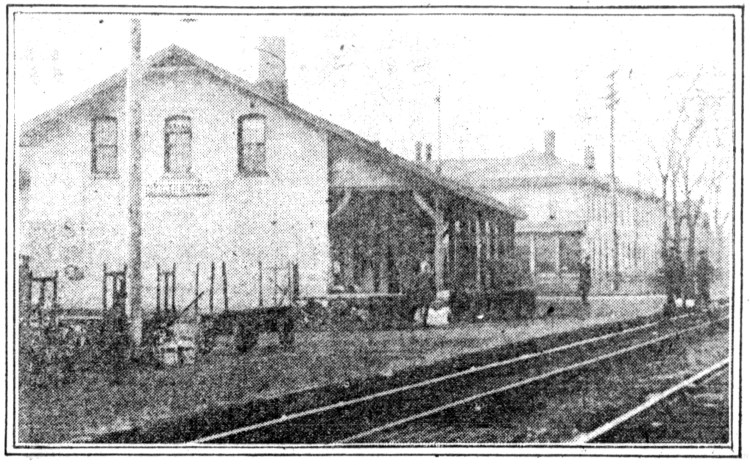
4-: From the caption to the following photograph, published in The Mansfield News (Mansfield, Ohio, USA) of Sunday 18th December 1921 [page 3, column 2]:
Here’s Pennsylvania Side of Union Sation As Casually Caught by a Candid Camera
Sixteen years ago James M. McCrea, then vice-president and later president of the Pennsylvania railroad, said “It’s not what one would call an ornament to the town.” Candor compels concurrence.
5-: From The Southwest Courier (Oklahoma City, Oklahoma, USA) of Saturday 13th December 1924 [page 5, column 4]:
Rupert of Hollywood
(By Rev. Will W. Whalen)
(Special to The Southwest Courier)Many, if not most, men are a bit dissatisfied with the role they’re playing here below, and hanker to be something and somebody else. Charles Dickens, the father of “Little Nell” and the “Marchioness”, yearned to be a low-brow stage comedian. Margaret Anglin, our greatest living emotional actress, wishes the public would accept her as a bright, merry comedienne.
Rupert Hughes, a fine short story writer attempts to make a tittering public believe he’s a deep-thinking theologian. Lil’ Rupert’s latest photo shows him in a serious pose in a popular magazine, sitting very much a petty pope, pronouncing ex cathedra. The candid camera betrays that lil’ Rupert’s lost his figure, and put on another tire under his chin. One wonders whether the fat hasn’t boiled up into his head.
6-: From the caption to the following photograph, published in The Graphic: The National Weekly (London, England) of Saturday 11th May 1929 [page 265]:
Specially taken for “The Graphic” by Dr. Erich Salomon 6
THE DISTINGUISHED COMPANY AT THE ROYAL ACADEMY BANQUET: AFTER-DINNER SPEAKERS AND LISTENERS
An unconventional snapshot, taken with an intensely powerful pocket-camera during the speech of the President of the Royal Academy (Sir William Llewellyn) at the annual banquet in Burlington House after the opening of the R.A. Prince George, who responded to the Toast of the Royal Family, is seen on Sir William’s right. At the foreground table, unaware of the proximity of the candid camera, will be seen Dean Inge enjoying his cigar. Next to him is Field-Marshal Sir William Robertson, and farther along Lord Ebbisham. Among others who can be picked out from among the main body of distinguished guests are Lord Davidson, former Archbishop of Canterbury, and Lord Crawford.
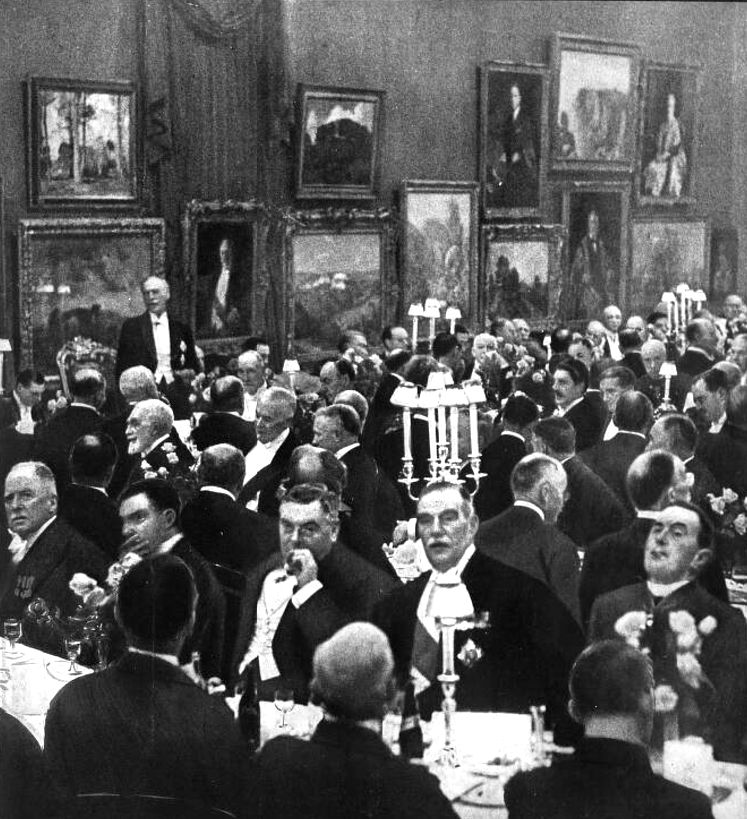
6 The German Jewish photojournalist Erich Salomon (1886-1944) was the original ‘candid camera’ photographer.
7-: From an advertisement for The Graphic: The National Weekly (London, England), published in The Bystander (London, England) of Wednesday 15th May 1929 [page N, column 1]:
SEE EACH WEEK THE GRAPHIC
“UNSUSPECTED MOMENTS”The special “Candid Camera” that goes the round of public dinners and functions, and takes remarkable unposed pictures.
 word histories